Author: DMcA

  • Apulia Street and Beach

    In July 2017 my daughter, granddaughter and I went on a longish trip to the Adriatic coast of Italy. Seascape images from that trip are shown in a separate album. Most of our time was spent in the province of Apulia, or Puglia, which has the longest coastline of any in Italy. It runs from the spectacular Gargano peninsula down to the boot heel of Italy, and has many opportunities for eating and sightseeing.


    This album is a selection of street and beach photographs from the trip. In addition to my Olympus E-M1 Mk II, I also took the Panasonic Lumix GM5 specifically for street photos. Both of these cameras use the same interchangeable lenses, but the GM5 is one of the smallest cameras of it’s type ever made, so it was perfect as a permanent carry for when the opportunity arose. Being Italy, many such opportunities occurred, from a sinister looking group of post-prandial priests in Trani , to a fabulous wedding in Lecce, shot from above.


    Touch or click any image to go to a lightbox view and then touch the full screen icon in the top right hand corner to get the best viewing experience. And for information on the shot and the location, be sure to click the little ‘i’ icon
  • Adriatic Trabucci and Seascapes

    In July 2017 my daughter, granddaughter and I went on a longish trip to the Adriatic coast of Italy. We started in the foothills of the Abruzzi mountains, and pottered down to Otranto on the boot heel of the country. My granddaughter was just over 6 months old at the time, and was already an enthusiastic traveller (and eater).


    I took thousands of photos on that trip with my (then) brand new Olympus E-M1 Mk II camera. On returning to the UK I never considered the images for showing to anybody but family, partly because of time constraints, and partly because I didn’t think I had taken many memorable shots.


    One reason for this, was the extreme contrast between light and shadow in Italy in the summer. I allowed for this by bracketing the exposure on the photos at the time, but the software technology then available made post-processing very difficult (and beyond my skill level). But recently, I came across the photos again, and using my improved skills and the vastly improved software, had another go.


    The images are taken in two locations, almost all at sunrise. The first set are of the delightful Trabucci of Chieti province. Trabucci are spindly fishing jetties built out into the sea, and are very similar to the Carralet of the Gironde estuary in France (which have their own album on this site, accessible from the top menu). Some of the Trabucci have been turned into restaurants, and some are falling apart, but a surprising number are still operational.


    The second set of images are of the lovely sea stack, inlets and cliffs of Puglia, just up the coast from Otranto. Unlike the British coast where there are also many sea stacks, these are a honey gold colour in the morning, and the sea is warm, so you can (and I did) swim out to them as well as take photographs.


    Touch or click any image to go to a lightbox view and then touch the full screen icon in the top right hand corner to get the best viewing experience. And for information on the shot and the location, be sure to click the little ‘i’ icon

  • Frozen small things

    A while back, I acquired the amazing OM systems pro 90mm f3.5 macro lens. This is a unique piece of optics, rather expensive, but one of the best macro lenses ever made. It sat for a while unused, as I didn’t have any particular subjects in mind. But a month ago, I was out walking in the local (Royal) park in the early morning with a friend, and we noticed the frozen tips of the ferns glinting in the low morning sun. It occurred to me that frozen tips of plants and buds might make an interesting set of images to christen the 90mm lens with. I spent a fascinating hour or so in the freezing morning light in our Japanese gardens a day later and took around 1600 images (for various reasons it’s about 50x images per view). Here are the 12 best, and I hope you like them.

  • Perfect long exposure with physical ND filters

    The core problem with ND filter work is knowing which filter strength to use before attaching it; I solve this with exposure tables that map base shutter speed directly to the required ND for 1, 2, and 4-minute exposures, eliminating trial-and-error in the field. For a 2-minute exposure on a bright day, the answer is 1/640s plus 16 stops of ND; on an overcast day it is 1/80s plus 13 stops — two figures that are easy to remember before setting out.

  • OM-1 settings for landscape and long exposure photography

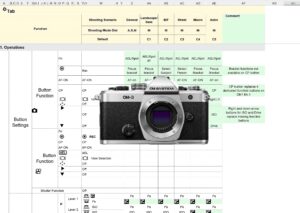
    The OM-1’s landscape custom setting drives every computational feature — Hi-Res shot, Live ND, HDR, focus bracketing, and GND — from a single dial position, with one-press custom buttons giving access to each mode without entering the menu. These settings and cheat sheets, along with downloadable .set files for both OM-1 Mk I and Mk II, describe the approach I use to extract equal or better dynamic range than full-frame cameras using the OM system’s computational tools.

  • On1 Photo Raw – I’m all in

    After 16 years with Lightroom and 11 years with On1 Photo Raw running in parallel, I completed the move to On1 as my primary software and have not gone back. The core reason is architectural: On1 combines layers, filters, DAM, and fully non-destructive editing in a single application, whereas getting equivalent capability from Adobe requires both Lightroom and Photoshop — two programs with completely different interfaces and a file management overhead that compounds with every complex edit.

  • Matching the best camera system to the occasion

    I now classify photo trips by how critical the camera system is — from once-in-a-lifetime photo-focused trips where the best system with a backup is warranted, down to travel-first trips where even the smallest kit is fine. After testing multiple full-frame alternatives against the OM system, my conclusion is that the OM-1 covers BIF-first and multi-genre trips, the Z7 covers landscape and astro-first trips, and the OM-3 covers everything else.

  • OM1 vs R5, A1 and Z8: which is the best all-round system?

    Testing the Canon R5, Sony A1, and Nikon Z8 paired with lightweight telephoto lenses at 600–800mm against the OM-1 and 300mm f4, none of the full-frame alternatives produced better BIF output — all three had worse net noise when the slower lens apertures were factored in, and most lacked pre-capture RAW or live exposure blinkies. The least-worst full-frame option was the Nikon Z7 or Z8 with the 500mm PF f5.6, which reached approximate noise parity with the OM-1 at 750mm in crop mode but still could not match the frame rate or pre-capture capability.

  • Taiwan – Alishan forest, Tainan skies and Lions Head mountain

    Continuing our journey down the mountainous central spine of Taiwan, we headed for Alishan – a celebrated ancient forest with millennia-old cypress, yellow cedar and spruce trees and a famous railway. Stopping off for a few days rest in Tainan (and catching some amazing skies) we continued to the last of our mountain destinations, Shitoushan Quanhua Temple on Lions Head Mountain in the north west of the country.


    Touch or click any image to go to a lightbox view and then touch the full screen icon in the top right hand corner to get the best viewing experience. And for information on the shot and the location, be sure to click the little ‘i’ icon

  • Taiwan central mountains – Taipingshan to Henuanshan

    In September 2024 I spent two weeks in Taiwan. It is not a popular tourist destination, and neither I nor my companions had ever travelled there. We all wanted to go however as it may change fundamentally over the next few years if the mainland Chinese decide to invade. It is also a relatively small island, about 400 km long, so under half the length of Great Britain, and in principle quite easy to tour around. Additionally it held the promise of the Chinese way of life in a democratic environment, plus great food, and possibly nice scenery.


    We spent more time planning this trip than on any other I have taken, and by and large this paid off. Roughly speaking we spent half the time in the two main cities, Taipei and Tainan, and the other half in the mountains, avoiding the coastal plains except to travel. Both the cities and the mountains were a revelation, but this album is focussed on the amazing mountain scenery.


    Taiwan is formed from the junction of three tectonic plates, which have created a jagged mountainous area down the central spine of the island. The island appeared around 5 million years ago – very young compared to the Himalayas, also regarded as new, which rose 40-50 million years ago. The central part of Taiwan is still rising, and there are many earthquakes in the region. The mountains are extraordinarily steep sided, but are in a subtropical evergreen region, creating a quite unique and photogenic landscape. These photographs are from the first leg of the journey from Taipei to the Henuanshan mountains. The next album covers the second leg and includes Tainan and an amazing mountain monsatery.


    Because this was a travel experience for us all, and not a photography oriented trip, I took a small lightweight system with me, the OM System OM5 and lenses. It worked amazingly well, and there were few compromises, as you might be able to see.


    Touch or click any image to go to a lightbox view and then touch the full screen icon in the top right hand corner to get the best viewing experience. And for information on the shot and the location, be sure to click the little ‘i’ icon

  • Taiwan and Cambodia street

    Street photos from Phnom Phen (first two) and Taiwan (mostly Taipei and Tainan). I wasn’t really looking to do much street, but Taiwanese people are interesting, particularly in the many night markets across the country.

  • La Rocheliere

    In an earlier album, I revisited the area around our place in Cape Town, as I felt that over the years I had not really done photographic justice to it. We have owned our house in France for even longer, nearly 30 years, and although there were a few prior photos I liked, once again I felt that I should now try to take some definitive shots, using newer technology, better post processing software, and my slightly improved photographic eye.

    Our place is deep in the heart of rural France, and although quite lovely, it doesn’t have the dramatic seascapes that Cape Town enjoys. The beauty of the countryside is more subtle, and difficult to capture. It is also impacted by the French approach to farming, which is to create huge featureless fields on the one hand, or to leave woods and forests completely untended on the other. So often there is either not enough countryside detail, or too much. What the area has however are numerous drop-dead gorgeous towns and villages tucked in along the winding river Gartempe, with spectacular Abbeys, Chateaus and old mills along the river banks.

    This album contains all my favourite photos of the area. All the locations are within a 20 minute drive of our fermet ,and they remind me why we think of this place as our second home and love it so much.


    Touch or click any image to go to a lightbox view and then touch the full screen icon in the top right hand corner to get the best viewing experience. And for information on the shot and the location, be sure to click the little ‘i’ icon