Author: DMcA

  • Taiwan – Alishan forest, Tainan skies and Lions Head mountain

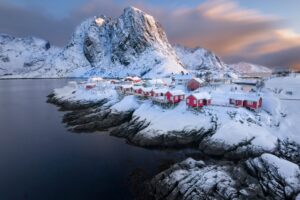
    Continuing our journey down the mountainous central spine of Taiwan, we headed for Alishan – a celebrated ancient forest with millennia-old cypress, yellow cedar and spruce trees and a famous railway. Stopping off for a few days rest in Tainan (and catching some amazing skies) we continued to the last of our mountain destinations, Shitoushan Quanhua Temple on Lions Head Mountain in the north west of the country.


    Touch or click any image to go to a lightbox view and then touch the full screen icon in the top right hand corner to get the best viewing experience. And for information on the shot and the location, be sure to click the little ‘i’ icon
  • Taiwan central mountains – Taipingshan to Henuanshan

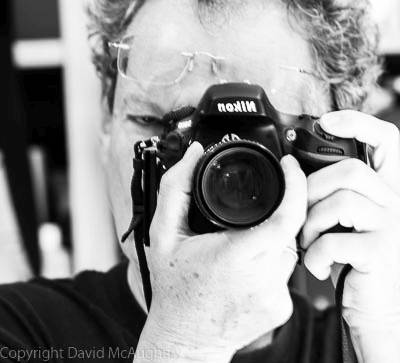
    In September 2024 I spent two weeks in Taiwan. It is not a popular tourist destination, and neither I nor my companions had ever travelled there. We all wanted to go however as it may change fundamentally over the next few years if the mainland Chinese decide to invade. It is also a relatively small island, about 400 km long, so under half the length of Great Britain, and in principle quite easy to tour around. Additionally it held the promise of the Chinese way of life in a democratic environment, plus great food, and possibly nice scenery.


    We spent more time planning this trip than on any other I have taken, and by and large this paid off. Roughly speaking we spent half the time in the two main cities, Taipei and Tainan, and the other half in the mountains, avoiding the coastal plains except to travel. Both the cities and the mountains were a revelation, but this album is focussed on the amazing mountain scenery.


    Taiwan is formed from the junction of three tectonic plates, which have created a jagged mountainous area down the central spine of the island. The island appeared around 5 million years ago – very young compared to the Himalayas, also regarded as new, which rose 40-50 million years ago. The central part of Taiwan is still rising, and there are many earthquakes in the region. The mountains are extraordinarily steep sided, but are in a subtropical evergreen region, creating a quite unique and photogenic landscape. These photographs are from the first leg of the journey from Taipei to the Henuanshan mountains. The next album covers the second leg and includes Tainan and an amazing mountain monsatery.


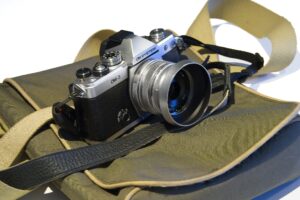
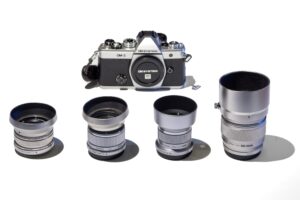
    Because this was a travel experience for us all, and not a photography oriented trip, I took a small lightweight system with me, the OM System OM5 and lenses. It worked amazingly well, and there were few compromises, as you might be able to see.


    Touch or click any image to go to a lightbox view and then touch the full screen icon in the top right hand corner to get the best viewing experience. And for information on the shot and the location, be sure to click the little ‘i’ icon
  • Taiwan and Cambodia street

    Street photos from Phnom Phen (first two) and Taiwan (mostly Taipei and Tainan). I wasn’t really looking to do much street, but Taiwanese people are interesting, particularly in the many night markets across the country.

  • La Rocheliere

    In an earlier album, I revisited the area around our place in Cape Town, as I felt that over the years I had not really done photographic justice to it. We have owned our house in France for even longer, nearly 30 years, and although there were a few prior photos I liked, once again I felt that I should now try to take some definitive shots, using newer technology, better post processing software, and my slightly improved photographic eye.

    Our place is deep in the heart of rural France, and although quite lovely, it doesn’t have the dramatic seascapes that Cape Town enjoys. The beauty of the countryside is more subtle, and difficult to capture. It is also impacted by the French approach to farming, which is to create huge featureless fields on the one hand, or to leave woods and forests completely untended on the other. So often there is either not enough countryside detail, or too much. What the area has however are numerous drop-dead gorgeous towns and villages tucked in along the winding river Gartempe, with spectacular Abbeys, Chateaus and old mills along the river banks.

    This album contains all my favourite photos of the area. All the locations are within a 20 minute drive of our fermet ,and they remind me why we think of this place as our second home and love it so much.


    Touch or click any image to go to a lightbox view and then touch the full screen icon in the top right hand corner to get the best viewing experience. And for information on the shot and the location, be sure to click the little ‘i’ icon

  • Small things

    Photography can cover extremes in technique and dimension, from wide angle shots of expansive landscapes, to long exposures of the sea to the high speed capture of birds in flight. One area that up to now I have not explored is the world of very small things, otherwise known as Macro Photography.

    Macro presents a few unique challenges that make it one of the harder genres of photography to master. Firstly, by definition, the subjects are very small, and this typically means the camera lens has to be very close up – maybe 2-3 inches away.

    Secondly, special lenses are required that focus this close – called, unsurprisingly, Macro lenses. Being so close means that it is very easy to disturb the plant or insect, so getting a still subject is a challenge. And even if the leaf or flower is still, insects still insist on moving their legs about, making sharp pictures difficult. This means that the macro photographer can take literally hundreds of images before getting a portfolio quality shot.

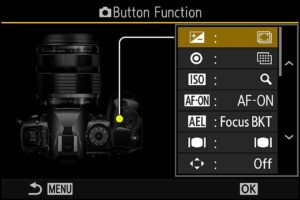
    Finally, the physics of lenses means that when very close up, the area of the subject in focus is very narrow, so it is very hard to get the whole subject sharp.. There are two solutions to this: firstly narrow down the lens aperture to increase the depth of field (like screwing your eyes up to see tiny detail), or secondly taking dozens of images, all focussed on different points on the subject, and then combining them in a method called “Focus Bracketing”. The first reduces the light to the lens enormously, so requires a flash to be used as well. And the second involves stacking 20-100 images together in a complex process. All of this is in addition to the other aspects of photography, like composition, colour etc.

    It turns out that for lots of technical reasons, the Olympus and OMD cameras are perfect for Macro photography, and in fact are the choice of very many macro photographers who can use any brand they like. And once you have the camera, the lenses (or some of them) and ancillary equipment are not too pricey. A detailed post on why the OMD cameras are so good for macro will be in a later post. So I armed myself with all the kit and started taking Macro pictures in England and France. The photos below are what resulted. I hope you like them.


    Touch or click any image to go to a lightbox view and then touch the full screen icon in the top right hand corner to get the best viewing experience. And for information on the shot and the location, be sure to click the little ‘i’ icon
  • Dawn in Wall Street

    Last November the Chickadee was in NYC over the weekend for a conference and suggested I come over to join her. In a previous life, I had commuted to New York every week for 12 years, and for 18 months during that period the Chickadee had an apartment down in the east village. So it would be nice to revisit old haunts and check out our favourite locations for dance, jazz and food again.

    After 17 years this was my first return trip to Manhattan. We had an insanely good time, and I was reminded all over again why I travelled there so many times (around 500 visits).

    As we were going to be zipping all around the city, I didn’t want to take a major camera kit with me. I brought my tiny Nikon 1 camera and an array of tiny lenses, with the vague aim of shooting some street shots and some river views. For most of the weekend, I didn’t get anything worth keeping. But on the last morning I went down to the Brooklyn bridge to get some shots at sunrise.

    Afterwards I wandered into the nearby Wall Street area with the faint hope that I might get some street shots there. Everyone was coming into work at this time, and the sun was low and hard, coming through the gaps in the buildings. I used the opposite of a normal street lens, which is usually the classic 35mm wide angle. Instead I used a 300mm telephoto, so perspective was compressed and the scene was quite narrow. I waited until people came into the shafts of sunlight, and spot metered only on the faces, rather than on the whole scene. As a result the images have intense contrast – I did very little to them other than to adjust the exposure and contrast slightly. I also ran the camera in burst mode at 10 frames per second.

    Because of the huge impact of the shafts of light, images taken fractions of a second apart are quite different, even though they may feature the same people – such as the sequence with the blue mask later in the series. Anyway, I hope you like them.


    Touch or click any image to go to a lightbox view and then touch the full screen icon in the top right hand corner to get the best viewing experience. And for information on the shot and the location, be sure to click the little ‘i’ icon