-
-
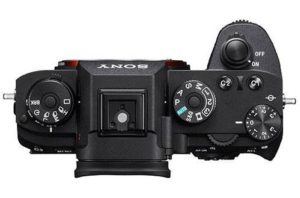
Sony A9 focus accuracy – birds in flight hit rate
Detailed analysis using AFV.exe to check the focus point location for 1,600 A9 shots showed that even when the camera placed a focus point directly on the bird, the resulting image was out of focus 40% of the time — camera error, not user error. The afternoon session hit rate of 39% reflects a genuine limitation in demanding conditions, not the test methodology.
-
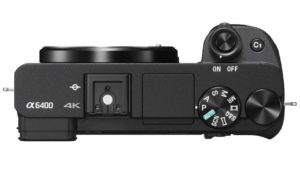
Sony a6400 for birds in flight
Over 3,441 shots across seven sessions at Andover and Richmond Park, the Sony a6400 averaged 35% focus accuracy for birds in flight despite trying every published autofocus setup recommendation. The ergonomics made a difficult situation worse: a tiny viewfinder aperture that requires near-squinting to use, a stiff rear control dial, intrusive exposure zebras that obscure the subject, and no proper battery grip available from Sony or third parties.
-
A9 missed focus
I got a surprisingly low focus hit rate for the A9 camera I tested. Was I just missing focus? I checked 850 A9 shots for where the actual focus point was in the image. Here are some examples of where the focus point was right on the bird but the image was out of focus. Each image shows the AFV.exe screen on the left, showing the location of the focus points, and a higher resolution of the same image on the right, showing the level of focus. On the testing day, there were 299 images where the camera failed in this way.
Touch or click any image to go to a lightbox view and then touch the full screen icon in the top right hand corner to get the best viewing experience. -
APSC vs Olympus noise and dynamic range -which is best?
Full-frame cameras used in APSC crop mode lose their full-frame noise advantage entirely — the cropped area has the same noise characteristics as a native APS-C sensor, which is identical to the Olympus cameras. Since the OM system’s faster lenses cancel out the remaining sensor noise difference in direct comparisons at matched apertures and focal lengths, the noise case for choosing full-frame over Olympus for birds in flight effectively disappears.
-
-
Post-processing workflow for birds in flight
Importing 400+ keeper images into Lightroom first and then exporting to specialist tools becomes impractical at scale — the workflow is too slow and the round-trips compound. The approach I use: cull in FastRawViewer, batch denoise and optically correct in DxO Photolab, apply dynamic contrast and resize in On1 PhotoRaw, and bring only the finished images into Lightroom for final metadata and culling.
-
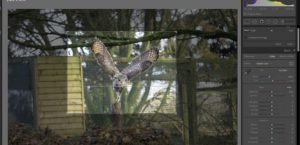
Owls pre and Post Dynamic contrast
This shows the owl photos before and after some dynamic contrast is added, and final touches are done on the image. The first image of each pair is the final version, to which a small amount of “On1 Photo RAW” dynamic contrast (DC) has been added, along with tonal adjustments. For some photos, background distractions have also been removed. The second image of each pair, labelled “Owl-Pre DC-xx” are after noise reduction (but no sharpening) in Topaz Denoise AI, and before the final adjustments were made. They have been cropped and given some Lightroom exposure and contrast adjustment to match the final images, but there is no sharpening.
Touch or click any image to go to a lightbox view and then touch the full screen icon in the top right hand corner to get the best viewing experience. And for information on the shot and the location, be sure to click the little ‘i’ icon -
Noise and DR roundup for Sony A9 and EM1x
The EM1x’s noise at matched focal length and aperture is within 0.5 stops of the A9’s, and at ISO 3200 and above where birds-in-flight shooting actually occurs, the gap is negligible after standard denoising. The reason Olympus users perceive worse noise is usually that they are comparing against full-frame cameras with faster lenses — once the comparison accounts for matched apertures and magnification, the EM1x frequently looks cleaner in real-world files.
-
-
EM1x update on firmware 2 bird AF operation and settings
Four custom presets covering stationary birds with Bird AI, takeoffs and landings with ProCapture L, fast head-on subjects with CAF sensitivity -2, and general fast BIF with CAF sensitivity 0 give the EM1x the flexibility to handle every scenario I encounter without entering the menu between shots. The function lever in position 1 with exposure compensation on the rear dial is the most important single setup choice for consistently exposed BIF shots.
-
Multi-lens speed and noise comparison of EM1x to Sony A9
Matching the EM1x and A9 at equivalent subject magnification and aperture — rather than at the same focal length and ISO, which is the comparison most reviewers use — shows the two systems within 0.5 stops of each other at ISO 3200. The perceived noise advantage of Sony full-frame is largely an artefact of unfair comparison conditions that favour the larger sensor by ignoring how much more light the smaller-sensor OM lenses gather per pixel.