Posts

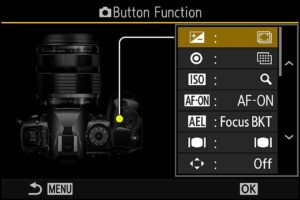
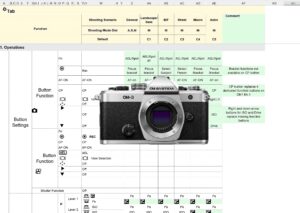
  • Giant OM-3 photo settings spreadsheet and best settings files across 5 genres

    The OM-3 shares the same sensor and imaging pipeline as the OM-1 Mk II but has a different button layout, so the OM-1 spreadsheets cannot be used directly. This post provides the complete OM-3 settings spreadsheet across all 400–500 menu items for five genres — landscape, birds in flight, street, macro, and astro — along with downloadable .set files for each genre and a landscape/LE cheat sheet.
  • OM-3  – not just a hipster street camera?

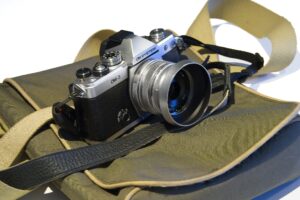
    The OM-3’s new CP (Computational Photography) button consolidates every computational feature into a single dial-controlled menu, freeing up four programmable buttons and making the camera more usable than the OM-1’s eight-button setup in practice. Five named custom settings, a separate video mode dial, and a combined body-plus-six-lens kit weighing 1,287g — less than a single Sony 200-600mm zoom — make it, in my view, the best urban and travel camera available.

  • Best lenses for the new OM-3 camera

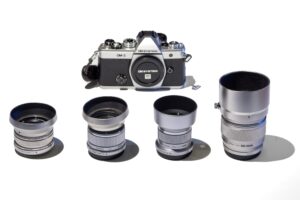
    The OM-3’s small, elegant body pairs best with compact lenses, and no camera system has a better collection of lightweight options than Micro Four Thirds, with over 100 lenses from seven optical companies accumulated over 17 years. A six-lens kit covering every genre from astro to wildlife — the Leica 9mm, Olympus 17mm, Olympus 9-18mm, Olympus 60mm macro, Panasonic 14-140mm, and Panasonic 100-300mm — weighs just 1,287g total, roughly 300g less than the Sony 200-600mm zoom alone.

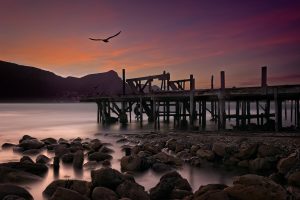
  • Perfect long exposure with physical ND filters

    The core problem with ND filter work is knowing which filter strength to use before attaching it; I solve this with exposure tables that map base shutter speed directly to the required ND for 1, 2, and 4-minute exposures, eliminating trial-and-error in the field. For a 2-minute exposure on a bright day, the answer is 1/640s plus 16 stops of ND; on an overcast day it is 1/80s plus 13 stops — two figures that are easy to remember before setting out.

  • OM-1 settings for landscape and long exposure photography

    The OM-1’s landscape custom setting drives every computational feature — Hi-Res shot, Live ND, HDR, focus bracketing, and GND — from a single dial position, with one-press custom buttons giving access to each mode without entering the menu. These settings and cheat sheets, along with downloadable .set files for both OM-1 Mk I and Mk II, describe the approach I use to extract equal or better dynamic range than full-frame cameras using the OM system’s computational tools.

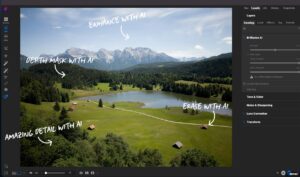
  • On1 Photo Raw – I’m all in

    After 16 years with Lightroom and 11 years with On1 Photo Raw running in parallel, I completed the move to On1 as my primary software and have not gone back. The core reason is architectural: On1 combines layers, filters, DAM, and fully non-destructive editing in a single application, whereas getting equivalent capability from Adobe requires both Lightroom and Photoshop — two programs with completely different interfaces and a file management overhead that compounds with every complex edit.

  • Matching the best camera system to the occasion

    I now classify photo trips by how critical the camera system is — from once-in-a-lifetime photo-focused trips where the best system with a backup is warranted, down to travel-first trips where even the smallest kit is fine. After testing multiple full-frame alternatives against the OM system, my conclusion is that the OM-1 covers BIF-first and multi-genre trips, the Z7 covers landscape and astro-first trips, and the OM-3 covers everything else.

  • OM1 vs R5, A1 and Z8: which is the best all-round system?

    Testing the Canon R5, Sony A1, and Nikon Z8 paired with lightweight telephoto lenses at 600–800mm against the OM-1 and 300mm f4, none of the full-frame alternatives produced better BIF output — all three had worse net noise when the slower lens apertures were factored in, and most lacked pre-capture RAW or live exposure blinkies. The least-worst full-frame option was the Nikon Z7 or Z8 with the 500mm PF f5.6, which reached approximate noise parity with the OM-1 at 750mm in crop mode but still could not match the frame rate or pre-capture capability.

  • OM5 custom settings explained

    The OM-5 has only one ‘hard’ custom setting on the mode dial (C), with three additional ‘soft’ settings (C2–C4) that can be recalled from buttons but are lost as soon as you press the Menu button — a behaviour that initially baffled me. The practical solution is to store landscape/base settings in C so they can always be recalled as a clean baseline, and use C2–C4 for specialist genres with the understanding that pressing Menu exits them.

  • OI share, OM1 and Pixel phones solution

    Unlike every other OM/Olympus camera, the OM-1 cannot connect to OI Share via direct Wi-Fi when unregistered — it requires the camera to be the registered device in the app, so switching between bodies requires a full deregister/reregister process. Android 14 introduced an additional compatibility break fixed in OM-1 firmware 1.6, requiring the Wi-Fi security setting to be changed from WPA2/WPA3 to WPA2 only in the camera menu.

  • Hot pixels in OM1 and OM5 Long Exposure photography

    Long exposure hot pixels are caused by cosmic ray-induced sensor defects that accumulate continuously over the camera’s lifetime — a known phenomenon that affects the OM-1’s smaller pixels more than the Nikon Z7’s larger pixels after several years of use. On1 PhotoRaw 2024 and Lightroom Classic both remove these automatically in post-processing, making in-camera noise reduction unnecessary and halving the time required for 2- to 6-minute exposures.

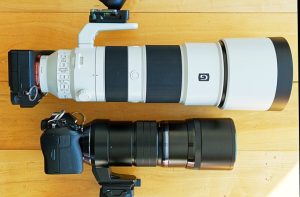
  • Best Olympus pro telephoto – surprising test results

    Testing the 300mm f4 prime against the 150-400mm f4.5 TC (Big White) at matching focal lengths using an ISO 12233 resolution chart at up to 20 metres, the 300mm f4 was unequivocally sharper than the BWL at every focal length, including with the MC-20 attached. More surprisingly, the 40-150mm f2.8 with teleconverters was also as sharp or sharper than the BWL — results that confirmed the smaller, lighter combination was the right choice and that there was no image quality price to pay.