Equipment analysis

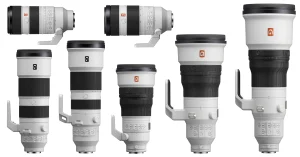
  • Sony Zooms vs the 600mm f4 Prime—comparative image quality

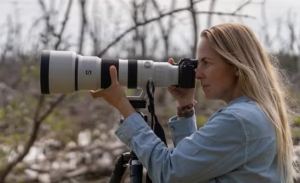
    Using standardised test data from The-Digital-Picture — the only widely available source with controlled lab comparisons of both the 600mm f4 GMaster and the wildlife zooms — the £12,000 prime shows minimal perceptible image quality advantage over the £1,600 200-600mm or the £2,400 400-800mm at 600mm. Independent numerical resolution data comparing exotic primes to wildlife zooms essentially does not exist, because manufacturers provide early samples to YouTube influencers rather than to test houses that might measure the difference.

  • OM and Sony wildlife zooms – lens handling

    The rotational inertia index for the Sony 400-800mm is 3.2 times higher than for the OM 50-200mm f2.8 without its tripod collar, which translates directly into how hard each lens is to swing when tracking a fast-moving bird. Neither Sony zoom has a focus preset function, and the Sony 400-800mm’s minimum focus distance of 350cm makes close subjects impractical; the OM 50-200mm with MC20 focuses to 78cm and delivers 2:1 FFE macro capability.

  • Dynamic Range and low-light noise – Sony vs OM zooms

    At true ISO 3200, DxO data shows the Sony full-frame sensor has approximately a 1-stop dynamic range advantage over the OM Micro Four Thirds sensor — but the OM pro zoom lenses are 1.3 to 1.7 stops faster than the Sony wildlife zooms at equivalent focal lengths, which cancels or exceeds that advantage. The Sony 200-600mm suffers a further penalty at 800mm: it must be cropped to reach that focal length, reducing the active sensor area to approximately APS-C size and eliminating both the resolution and full-frame dynamic range advantages simultaneously.

  • Giant OM-3 photo settings spreadsheet and best settings files across 5 genres

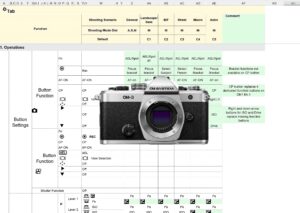
    The OM-3 shares the same sensor and imaging pipeline as the OM-1 Mk II but has a different button layout, so the OM-1 spreadsheets cannot be used directly. This post provides the complete OM-3 settings spreadsheet across all 400–500 menu items for five genres — landscape, birds in flight, street, macro, and astro — along with downloadable .set files for each genre and a landscape/LE cheat sheet.

  • OM-3  – not just a hipster street camera?

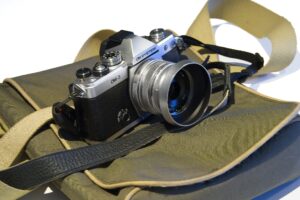
    The OM-3’s new CP (Computational Photography) button consolidates every computational feature into a single dial-controlled menu, freeing up four programmable buttons and making the camera more usable than the OM-1’s eight-button setup in practice. Five named custom settings, a separate video mode dial, and a combined body-plus-six-lens kit weighing 1,287g — less than a single Sony 200-600mm zoom — make it, in my view, the best urban and travel camera available.

  • Best lenses for the new OM-3 camera

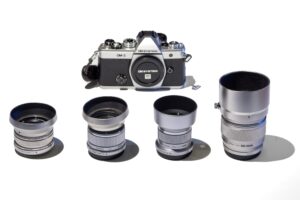
    The OM-3’s small, elegant body pairs best with compact lenses, and no camera system has a better collection of lightweight options than Micro Four Thirds, with over 100 lenses from seven optical companies accumulated over 17 years. A six-lens kit covering every genre from astro to wildlife — the Leica 9mm, Olympus 17mm, Olympus 9-18mm, Olympus 60mm macro, Panasonic 14-140mm, and Panasonic 100-300mm — weighs just 1,287g total, roughly 300g less than the Sony 200-600mm zoom alone.

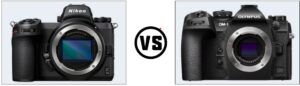
  • OM1 vs R5, A1 and Z8: which is the best all-round system?

    Testing the Canon R5, Sony A1, and Nikon Z8 paired with lightweight telephoto lenses at 600–800mm against the OM-1 and 300mm f4, none of the full-frame alternatives produced better BIF output — all three had worse net noise when the slower lens apertures were factored in, and most lacked pre-capture RAW or live exposure blinkies. The least-worst full-frame option was the Nikon Z7 or Z8 with the 500mm PF f5.6, which reached approximate noise parity with the OM-1 at 750mm in crop mode but still could not match the frame rate or pre-capture capability.

  • OM5 custom settings explained

    The OM-5 has only one ‘hard’ custom setting on the mode dial (C), with three additional ‘soft’ settings (C2–C4) that can be recalled from buttons but are lost as soon as you press the Menu button — a behaviour that initially baffled me. The practical solution is to store landscape/base settings in C so they can always be recalled as a clean baseline, and use C2–C4 for specialist genres with the understanding that pressing Menu exits them.

  • OI share, OM1 and Pixel phones solution

    Unlike every other OM/Olympus camera, the OM-1 cannot connect to OI Share via direct Wi-Fi when unregistered — it requires the camera to be the registered device in the app, so switching between bodies requires a full deregister/reregister process. Android 14 introduced an additional compatibility break fixed in OM-1 firmware 1.6, requiring the Wi-Fi security setting to be changed from WPA2/WPA3 to WPA2 only in the camera menu.

  • Olympus OM1 compared to Nikon Z7 for long exposure photography

    The Nikon Z7 has no exposure timer, no live feedback during long exposures, and requires 39 dial clicks to switch from a test shutter speed to bulb mode — three failures that make it extraordinarily frustrating for long exposure work. The OM-1 reaches bulb mode in one dial click, shows a live histogram during the exposure, and in my dark-frame noise tests at ISO 200 equalled or outperformed the Z7 at its base ISO of 64 across exposures of 2, 4, and 6 minutes.

  • AF for birds in flight with the Sony A9 and the 200-600 zoom

    The Sony A9’s PDAF array is linear — it detects vertical contrast well but struggles with horizontal contrast like a bird in profile, unlike the Olympus EM-series cameras which use cross-type sensors that detect any pattern orientation equally. This structural limitation, combined with the 200-600mm’s single focus motor and 2.1kg weight, explains why the A9 hit only 39% accuracy in the demanding afternoon session at the Hawk Conservancy Trust against the EM1x’s 45%.