OM and Sony wildlife zooms – 2026 summary
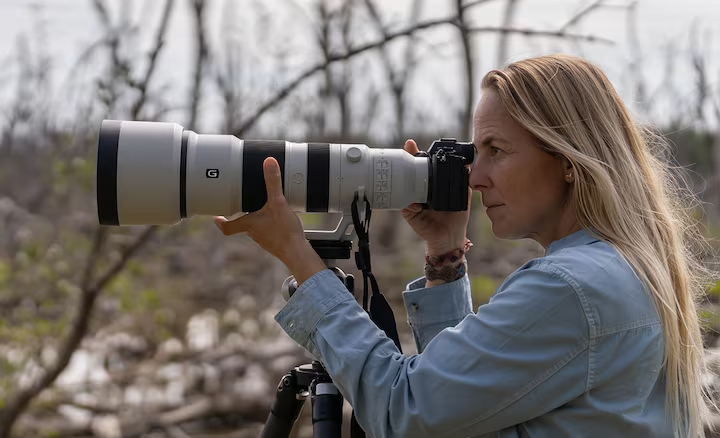
In April 2026, I put up five posts describing some testing and analysis of OM Pro zooms with the OM1 Mk II camera. Four of those involved comparisons against the Sony A7V camera and the two main Sony wildlife zooms.
Those posts were quite detailed, so in this summary article, I want to bring all the main conclusions about OM and Sony wildlife zooms together. Links to the relevant articles are included in the summary table below.
If you would rather head straight to a concise summary, the TL;DR is at the foot of the page — or jump directly to the Reader Q&A.
Why have I been doing all this testing?
I am not an obsessive tester, and I don’t like doing these detailed analyses very much. They are tedious, time-consuming and expensive to do.
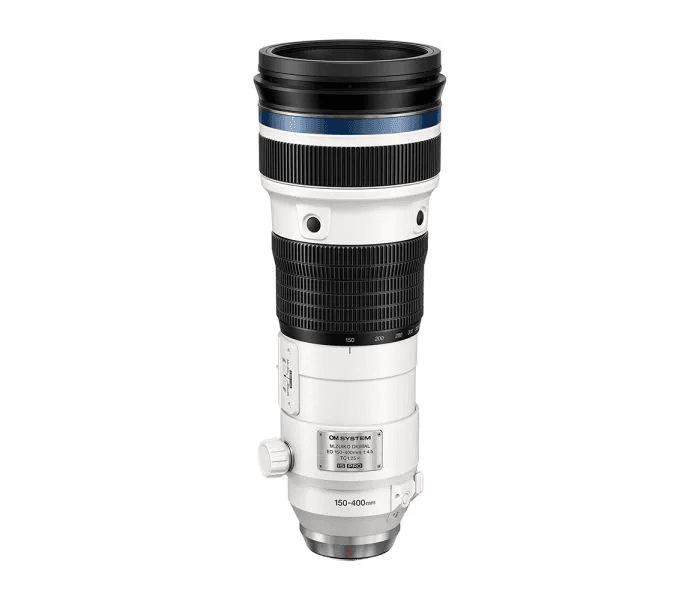
The background to all this is my indecision of many years about whether to buy the OM 150-400 f4.5 TC lens (the Big White, or BW). The minimum cost of this is £5000 in the UK, and a new dealer-bought, UK-warranted one is more like £6500. Every time I think about buying a BW, I ask myself the question: Is it worth the money to me, and what else could I get for that much?
I last did this kind of analysis two years ago, and summarised the results in this post, and this one. At that time, I compared the 300mm f4 prime to the BW, and concluded there was no difference in focus accuracy or resolution. I also concluded there were no better all-round systems on the market.
The trigger to doing it all over again was the amazing little 50-200 f2.8 (the Little White or LW), which, when paired with the MC14 and MC20 teleconverters, can take you up to 800mm FFE. I bought one and wanted to know if it could be a complete alternative as a zoom to the amazing BW, and if the Sony options had got better.
Why Sony?
First of all, I have nothing against Sony. These tests are not attacks on the brand at all. I have owned many Sony cameras from 2012’s NEX 5 onwards. I am a great admirer of their open mount lens policy, where almost every type of 3rd party lens will work. I will not buy Canon full-frame because their lens policy is totally closed, and I also don’t like Canon’s wildlife zoom lenses much. Nikon bodies are not remotely fast enough at the moment for birds in flight for me, and are also a closed mount for zoom lenses, except for old versions of Tamron zooms.
Plus, I really like Sony’s latest A7V camera. I can get a new A7V and the 200-600 f5.6-6.3 lens in the UK for £1000 less than the lowest cost of the BW. The new 400-800mm f6.3-8 is also great value. The question is, would they be any better than the OM1 and the white Pro Zooms? Here are the answers to those questions. The respective detailed posts are linked to in the Criteria column.
Summary of tests and analysis
| With OM1 Mk II | With A7V | |||
| Criteria | LW | BW | 200-600 | 400-800 |
| Weight (Kg) | 1.2/1.4 | 1.9 | 2.1 | 2.5 (dealbreaker) |
| Focus accuracy % | 95 | 92 | 90 | 98 |
| Resolution at 800FFE (LPI) | 24 | 25 | 21 | 32 |
| Dynamic Range | = | = | = | = |
| Low light noise | = | = | = | = |
| Winners | LW | 400-800 |
OM and Sony wildlife zooms: comments
These tests have surprised me and a few other people. I had not expected the LW to perform so well. It brilliantly delivers on the 4/3 promise of excellent performance with low weight and very high tech.
The A7V and the 200-600 do not deliver sufficient performance for me to consider replacing my Nikon Z full-frame system. On the other hand, the 400-800 is a beast of a lens, and it performs amazingly well. But it is twice the weight of the LW, and so heavy that it would require a tripod or monopod everywhere I might take it.
Most of the time, this extra weight would not be worth the effort. The essence of bird photography with the OM system is to zoom in so that cropping is not required. The resolution limitation of the 20MPx sensor then goes away.
Benefit of higher resolution systems
As my birding photography range broadens, a few situations have arisen where a higher resolution sensor and lens would really be useful.
The first of these is diving Kingfishers. It is impossible to follow the little buggers as they dive, so you have to have the camera in vertical orientation and zoom out so the whole travel from perch to water is in the frame. Then the bird is very small in the frame, and it is essential to crop in. The same was true when photographing the Resplendent Quetzal in Costa Rica. It is almost impossible to predict which way it will fly as it enters or exits the nest, so you have to zoom out to be able to catch it. A very high-resolution system would enable this approach to be taken without penalty.
The A1 Mk II at around 50Mpx is often suggested as the perfect camera for these requirements. The downside for me is the very high cost of the body, which makes assembling a complete system around it (including landscape and street lenses) very pricy for a edge case requirement.
One very interesting alternative is the rumoured A7RVI, which may have a 68 MPx semi-stacked sensor. If it can produce 30fps or better, this would be a beast of a camera, and would probably take the 200-600 to a resolution that would be worth paying for. With the 400-800, it would be at unheralded levels of resolution, and might again justify the cost.
We will see. In the meantime, I have around 7,500 amazing images from Costa Rica shot with the LW (from 70,000 shots in total) that I am very happy with, and that should keep me busy for a while.
TL;DR
- The OM 50-200mm f2.8 (Little White) delivers focus accuracy and resolution that match or exceed the much larger and more expensive Sony 200-600mm, with a much lower weight.
- The Sony 400-800mm f6.3-8 is the standout performer in resolution (32 LPI at 800mm FFE) and focus accuracy (98%), but at 2.5 kg it is heavy enough to be a practical dealbreaker for handheld bird-in-flight work.
- Dynamic range and low-light noise are effectively equivalent across all four lenses and both camera systems tested — neither platform has a meaningful advantage because the sensor advantage of the Sony cameras is cancelled out by the speed advantage of the OM lenses.
- The OM 150-400mm f4.5 TC (Big White) remains an excellent lens, but the LW with MC14/MC20 teleconverters covers similar ground at lower cost and weight.
- For situations requiring extreme crop latitude (diving Kingfishers, unpredictable flight paths), a higher-resolution sensor such as that in the A1 II or the rumoured A7R VI may offer a genuine advantage — but at considerable additional cost.
- The OM system’s combination of weight, reach, and optical quality continues to be difficult to match for handheld bird-in-flight photography at a comparable price point.
Reader Q&A
A reader and friend posed a number of thoughtful questions about the testing, and I thought it might be helpful to provide the answers here.
Was focus acquisition speed a factor in the results?
Speed of focus acquisition is very difficult to test quantitatively, and I have never seen a repeatable comparative test for it. However, I can comment on my qualitative experience. In a prior comparison, I found the Sony 200-600 to be slow to acquire focus, and it was the same with this set of tests. The 400-800 was much faster, and this is reflected in the new results — it was pretty equivalent to the BW and LW in focus acquisition speed, i.e., very fast.
Would an A1 II or A7R V be a better choice than the A7V for birds in flight?
Several people have made this point. As far as focus accuracy and dynamic range are concerned, the A7V, A1 II, and A9 III can be considered more or less equivalent — other data sources indicate that the focus system and noise/DR characteristics are very similar, with the A7V having the edge in the latter two. You are unlikely to do much better than the 98% focus accuracy achieved with the 400-800 on the A7V, whichever camera body you used.
There is no doubt, however, that you would get better resolution with the 50 MPx sensor of the A1 II compared to the 33 MPx sensor of the A7V. On the other hand, you pay roughly double the price for that, which is why I did not consider it as an option for this series of tests.
Are there circumstances where you might need to go beyond 800mm FFE?
As a bird-in-flight photographer, 800mm is the practical maximum I can follow a bird at. The requirement for more than 800mm is vanishingly rare — there were only two occasions out of many hundreds in Costa Rica, for example. If you photograph static birds, it is an entirely different story, and you might find the 400-800 or the 150-400 better options.
My overriding priority is the weight of the lens in my hand, so my solution for longer focal lengths is the Olympus/OM 300mm f4 prime (600mm FFE) with the MC20. This gives me a 1200mm FFE f8 lens with excellent stabilisation, weighing 1.4 kg — nearly half the weight of the 400-800.
How long did all this actually take?
The focus accuracy tests involved driving from London to Wales, which itself takes most of the day. The Gigrin testing takes a full afternoon, and I always leave another day in case more work needs to be done — so two full days, an overnight hotel stop, plus the return drive. I did that twice for this series. I also rented the Sony A7V, the 200-600, and the 400-800; I could not get them all from a single rental company, so assembling them at the same time involved another two days in London collecting and returning them.
End to end, the focus accuracy tests took two weeks and were not cheap. The resolution tests were done during the same rental week and can be done at home, though they are complex. Analysis of all the data took around a month. Writing up the posts took around another two weeks.
What about lens copy variation and manufacturing tolerances?
I did add a section on copy variation in this post, drawing on Roger Cicala’s extensive experience. For fixed lenses such as the 300mm f4 with the MC14/MC20, copy variation is likely to be small — they are mechanically stable. The greater variation occurs in zoom lenses, because of the number of moving parts. Roger’s conclusion is that there is rarely an outright bad copy, but zoom lenses will vary at different focal lengths — one copy might be sharper at the long end, another in the middle. There is, unfortunately, no published data on this specific to Olympus/OM lenses that I can find.
How does the LW compare to the 40-150mm f2.8?
I own the 40-150mm f2.8 and I am going to sell it. It is an amazing lens, but it was always tantalisingly too short for my needs. If I owned the 150-400, I think I would still want the LW, because it is also an exceptional macro and landscape lens in a way the 40-150 simply is not.
Have your OM-1 II settings changed as a result of this testing?
Not as a direct result of the testing, where I kept settings standardised and aligned with the Sony systems. They did change, however, as a result of taking 70,000 photos in Costa Rica. I ended up with all three custom settings configured for birds and one for macro/frogs. I have an updated settings spreadsheet which I will post soon, with notes on those changes.
Related Posts — OM vs Sony Series
Resolution
OM vs Sony Wildlife Zooms: Resolution Shootout
Focus Accuracy
Focus Accuracy Shootout: OM-1 II vs Sony A7V
Dynamic Range & Noise
Dynamic Range and Low-Light Noise: OM vs Sony
Lens Handling
OM and Sony Wildlife Zooms: Lens Handling
Zooms vs Prime
Sony Wildlife Zooms vs the 600mm f4 GMaster Prime
2026 Summary
OM and Sony Wildlife Zooms: 2026 Summary
Teleconverters & Focus
OM Pro Zooms: Effect of Teleconverters, ISO and Background on Focus Accuracy