Costa Rica Bird Photography 2026 – Itinerary and comments
I am writing this introduction in San Jose airport, Costa Rica, at the end of an epic 3-week bird photography trip. Along the way I met many extremely nice and interesting people, and exchanged tips and information with them. These included birding locations, travel tips and places to eat. Below I show my full itinerary for the trip along with a commentary on my experience at each place.
I will update this, correct the formatting, and add photos at a later date, but in the meantime, this is a repository of info for those people who expressed interest in places I had been or eaten. I hope it’s useful. The itinerary is in normal text, and the comments are in italics.
Costa Rica Bird Photography
Dates: March 13 – April 3, 2026
Flight: Friday, March 13, 2026: London Heathrow – Madrid on BA – Madrid – San José (SJO) on Iberia. Arrive 4:35pm. Uber to SJ.
- Carry-on Bag
- 56 x 36 x 23 cm (Strict AA limit)
- 10 kg (Strict Iberia limit)
- Personal Item
- 40 x 30 x 15 cm (Strict Iberia limit)
- Must fit under seat
Madrid airport was a bloody nightmare. Bags took an hour and a half to come off the plane. A normally adequate layover time became a manic race through the airport’s byzantine structure. Never again. I heard from another English guy that the way to go is via Toronto. Don’t have to immigrate and you avoid the USA completely. Prices through Canada air are also quite reasonable.
REGION I. SAN JOSE CITY AND ESCALANTE
San José Base (March 13–17):
Location 1: Apartment Bö Escalante 1107, 10101 San José, Costa Rica.
Bö Escalante is an elegant high-rise apartment in the otherwise low-rise Escalante area. It is by far the best place to stay in the district, and Escalante is by far the best area of San Jose to relax. Literally dozens of great cafes and restaurants, an active nightlife and only a 20-minute walk from the centre of town. Uber rides are very cheap (1000-1500) so getting anywhere is pretty simple. SJ was not as hot as expected , possibly due to unusual weather but a light jumper was needed in the evenings.
I particularly liked Franco for coffee, tea and dinner, and Amana for high end lunch and dinner. Everywhere in Costa Rica is expensive but in SJ, the price difference between a general purpose day-to-day place like Franco and a high-end place like Amana is not large.
In the city I really enjoyed the national museum which tells the whole story of Costa Rica with a particularly interesting part being the 1948 to 1949 civil war and the subsequent abolition of the army. In addition, the gold museum in the headquarters of the National Bank and the jade museum were well worth a trip.
Also in San Jose was a terrific little jazz bar, El Sótano, where I listened to a red hot piano trio until the early hours of the morning in a tiny basement room packed with 60 to 80 mostly young people. One of the best nights of jazz I’ve had in any country. One block away from here was an excellent high-end restaurant called il Silvestre, in a listed and rather beautiful building. There was a very good prix fixe lunch for I think 17k which for a meal of this quality was an absolute bargain in Costa Rica, that I had with their simple wine pairing (Cava and a glass of nice red wine)
San José / Vara Blanca (Mar 15-16). Temp: 32/18 RH: 50% Day: Lightweight hiking pants, breathable shirt, hat. Night: Light sweater or fleece and a rain shell.
Tuesday, March 17, 2026 : Car Rental (08:00): Toyota Rav 4 4×4 (Autounion). Pick up at office 8:00 am
Previous research had indicated that a 4×4 was needed, and for sure it was. I booked through Booking.com and from the offers available, I chose AutoUnion (a Greek based company) because it had the best combination of good reviews and reasonable prices. In reviews of other companies there were horror stories of other companies screwing extra money from minor dings to the car. I didn’t get that at all from these people, and there were zero issues when I returned the car. As noted below, I blew a tyre en-route, and had to replace it with a new one. They reimbursed me in cash on the spot for the new tyre, which I was not expecting. The counter guy was also extremely pleasant. I would use them again.
The office and car collection point was off-airport, in common with all except the major companies like Hertz and Avis. The car I got was a Toyota RAV 4 – a genuine 4×4. This is advisable, because the steepness of some of the roads requires pretty good traction, and a high ground clearance. It was also comfortable and fast on the highways and spacious. The Suzuki Jimny is another popular option, but it is noisy and slow on the highways, although a beast on rocky roads.
REGION II. THE SARAPIQUÍ BIODIVERSITY CORRIDOR (MARCH 17 – 23)
This region represents the Caribbean Slope Lowland Rainforest. Expect high humidity and dense forest canopy birding interspersed with specialized garden photography.
Sarapiquí (Mar 17-19) Temp: 34/22 RH: 80% Day: Moisture-wicking technical fabrics; long sleeves for bugs. Night: Breathable cotton; stays warm and humidity.
En-Route Attraction: The Waterfall Way (Highway 126)
On the drive from San José to Tirimbina, the route passes through the “Cloud Forest Transition Zone.”
- La Paz Waterfall Gardens: Features five massive waterfalls with specifically designed viewing platforms. The hummingbird garden is the highlight, featuring over 26 species in a high-density environment. Target species: Violet Sabrewing, Green Thorntail, and Coppery-headed Emerald.
- Map link
- Web site: https://waterfallgardens.com/contact_us/
- Phone +50624822720
- Open from 8:00 am $56. Check Butterflies, hummingbirds and
waterfalls. Allow 3 hrs, 9-12pm
La Paz Waterfall Gardens was an excellent place to visit and very good value. It’s an easy drive for a day trip from San Jose, or as I did it’s a nice stop on route to Sarapiqui. You commence by going through a butterfly house which is beautifully laid out with some magnificent butterfly species. The next thing is a hummingbird garden which I was impressed by as it was my first sighting of them. Given the huge number of hummingbird opportunities that occurred later in the trip it was in retrospect only of passing interest and not photographically great. Still fun though.
From then you can visit a series of five waterfalls which were all beautiful with a very nicely arranged trail that largely goes down river, so not too strenuous. Another very nice touch is that at the end of that trail, a bus takes you back to the starting point which massively reduces the exertion required for either the elderly or for children.
- Cinchona (The Hummingbird Café – Galería de colibríes y Soda Cinchona): A mandatory roadside stop. The balcony provides a “canyon-view” perspective to shoot Red-headed Barbets, Prong-billed Barbets, and Silver-throated Tanagers at eye level against a distant, blurred forest background. This is one of the best spots in the country for clean barbet portraits.
Lunch here after Waterfall gardens (10m drive)
- Contact: +50689197963
- Web description
- Map link
This was a nice place to stop for lunch after the waterfall trail, but ho-hum for photography. It was full of tourists and bird photographers and, at lunch time at least, the birds landing on the perches were relatively uninteresting. In addition this kind of perch is not the best place to photograph any bird. In future I would do no more than call by for a brief stop to see if there was anything interesting on the perch.
Location 2: Tirimbina Rainforest Lodge
Evening tour 17/3, morning personal guide Luis bird tour, Evening tour booked again 18/3.
- Stay Dates: March 17 – March 19
- Confirmed tours: Night walk tour March 17th at 7 pm ($40 USD/ shared tour). Bird watching private service March 18th at 6 am (cost $120 USD)
- The Site Detail: “Nature Right at Your Doorstep.” The 345-hectare private reserve is accessible by a scenic 262-meter long hanging bridge suspended over the Sarapiquí River. This bridge is a unique mid-canopy wildlife corridor used by monkeys, sloths, and birds. Guests can observe a rich array of tropical flora and fauna, including hundreds of bird species, all just steps from their room.
- Wildlife & Photography Highlights:
- The Bridge Perspective: Provides rare eye-level encounters with canopy species. Look for the Snowy Cotinga (one of the few reliable spots) and the Montezuma Oropendola.
- River Photography: The river banks are prime habitat for the Sunbittern (often seen displaying its wing patterns on the rocks) and three species of Kingfisher (Amazon, Green, and Ringed).
- Trails: Over 9 km of trails. The “Cacao Trail” is excellent for understory birds like the White-collared Manakin.
- Specialized Tours:
- Early Morning Bird Walk (6:00 AM): Highly recommended to catch the peak river activity.
- Night Frog/Bat Tour: Excellent for macro photography of Red-eyed Tree Frogs, Glass Frogs, and tent-making bats.
- Contact: +506 2761 0085 | tirimbina.org
- Map link
Tirimbina is an amazing place, but better for birders than photographers. It is notable because it has its own primary rainforest reserve on the other side of the Sarapiquii River, reached by a 262 m long chain suspension bridge across the river which is an experience in itself.
I took an early morning bird tour and an evening frog / insect tour. The bird tour was my first introduction to the difference between tours catering for a bird spotter vs a bird photographer. The former are quite happy if they see a tiny dot in the distance which is identified for them. In fact whole groups of them sit around in the evening filling in tick sheets of the birds they presumably saw during the day.
By contrast a bird photographer wants the bird to be right in front of them and, in my case, flying. This kind of situation was conspicuously absent in Tirimbina. We went out for 2 hours and I only got a handful of photographs of any interest, but at the end of it the guide proudly presented me with a list of 33 species which we had apparently seen.
This is probably Nirvana for a bird spotter but it was not ideal for me. As an aside, in common with many other tours of this kind we spent probably 30% of the time in the car park looking at trees surrounding it. I did get a fantastic picture of a macaw exiting a hole in a tree and flying away, but in general car parks are as uninteresting as you might imagine.
The night tour was more interesting, with many frogs, spiders and snakes being pointed out by our enthusiastic and knowledgeable guide. Night photography flashes are not permitted here and in most other places in Costa Rica as it disturbs frogs and snakes and can damage their eyesight. Knowing this but wanting some night photographs I took a small constant LED light on a flexible stalk and after a while I figured out how to use this and got some quite nice photographs. A tip here: getting the settings right is best done before you go on your night tour as opposed to stumbling around the dark trying to set your camera up as I did.
The hotel reception is something like 300 to 400 m from the gravel car park so getting your cases in is a real pain at the backside. They will take them in a trolley, but if you are unfortunate enough to be behind a large coach party, as I was, it can take hours.
It is also very heavily patronised by tour buses, and large tour groups. The hotel room was very basic but serviceable. The restaurant was not great, and the breakfast in particular was so bad that I didn’t eat there again. Overall, I’m glad I went, but it wasn’t a rich source of bird photos.
Location 3: Ara Ambigua Lodge
(emailed direct and BC)
- Stay Dates: March 19 – March 23
- The Site Detail: Designed as a biological corridor with sprawling grounds. The lush, landscaped gardens are specifically engineered with host plants to attract endangered Great Green Macaws. The lodge provides a more open habitat than Tirimbina, making it easier to track flight paths and garden-feeders.
- Wildlife & Photography Highlights:
- Macaw Observation: The Lodge is a key feeding site for the Great Green Macaw. Look for them in the Dipteryx (Almond) trees around the property.
- Garden Feeders: Excellent for Keel-billed Toucans, Collared Aracaris, Grey-necked Wood-Rails, and various Tanagers.
- Contact: +(506) 2766 7101, +(506) 2766 6401 hotelaraambigua.com info@hotelaraambigua.com Map link
An amusingly awful hotel experience. In a trend that I noticed all through the trip I was put into a room that was almost but not quite the farthest one from the restaurant and pool. The air conditioning was barely effective and in the seating area there was no air conditioning at all. It was also a difficult car drive from this room to the hotel reception and restaurant. I complained and they moved me to a massive suite that was even farther from the restaurant. In a trend that was to be repeated subsequently it was also up a nearly 45 degree gravel drive (so cases had to be carried) with no lighting.
Getting the cases up to this was an absolute nightmare. The suite was almost comically palatial but lacking sorely in some key features. The main problem was that the door didn’t lock but also the only bedside lighting provided was some sort of endless LED strip light which kept flashing intermittently and was therefore unusable.
I repeatedly told them about the problem with the flashing bedside light but it was never fixed. If you could wangle a better room it might be a nice place to stay because the restaurant was quite decent and it had lovely gardens with some very nicely arranged feeders. I would certainly stay there or thereabouts instead of Tirimbina.
The Sarapiquí Photography “Deep Dive” Circuit (Nearby Hubs)
While staying at Ara Ambigua, I scheduled day trips to the following private photography reserves.
1. Cope’s Wildlife Garden (Donde Cope)
Booked for 8-12 am 21/3, $30.
This is arguably the most famous photography garden in the Caribbean lowlands. José “Cope” Pérez is a legendary naturalist and artist who has meticulously designed his garden for high-end photography.
- The Detail: Features specialized perches for hummingbirds, tanagers, and honeycreepers. He is famous for knowing the exact locations of roosting Crested Owls, Spectacled Owls, and Grey-necked Wood-Rails.
- Location: La Unión de Guápiles (approx. 45–50 mins from Sarapiquí).
- Map Link: Donde Cope / Cope Wildlife
- Contact: +506 8352 9294 / +506 5067-136-5472 (WhatsApp) | Wildlife Copearte: +506 7136-5472, F/Copearte, email: Copearte@Gmail.Com, web: www.Copeartecr.Com
- Del Cruce De Río Frío 2.5 Km Primera Entrada Mano Derecha La Unión De Guapiles
An absolutely fantastic and highly memorable visit. Cope is an extremely talented artist and photographer and a very humble and self-effacing man with a profound knowledge of the local wildlife. You visit his house, which is very simple but set up with a viewing platform over an amazing little river that runs right through his back garden. After a while there, he set off with a machete to take us into the jungle where we saw some very interesting species of owls and other unique bird life that I didn’t see anywhere else on the trip.
On returning to his place he had a set of studio lights set up around a succulent flower with hummingbirds freely coming in and out which made for a beautiful photo environment without flash. I got some lovely hummingbird shots in this session. And finally to our delight and astonishment he had a mother and child sloth in his back garden who came down a tree to the ground very slowly no more than 2 m from us. This was one of the most unique experiences of my trip, given that most people only ever see a sloth as a lump of fur at the top of a tree 50 m away.
The key thing about Cope is that he is an artist and produces beautiful photographs and paintings. He understands what a photographer is looking for and this was night and day from the bird spotting guides I encountered during my trip.
2. Dave and Dave’s Nature Pavilion
Booked 3:30pm 19/3
Located very close to your stay at Tirimbina, this facility was built specifically for bird photography.
- The Detail: They have two levels of photography decks. The Upper Deck puts you at eye-level with the canopy of the forest, providing the clean, distant green backgrounds (bokeh) ideal for shots of Toucans and Aracaris.
- Targets: Keel-billed Toucans, Collared Aracaris, and high-speed hummingbird setups.
- Location: La Virgen de Sarapiquí (approx. 10–15 mins from Tirimbina).
- Map Link: Dave and Dave’s Nature Pavilion
- Contact: +506-83467066 (WhatsApp) | Official Website, email: crnpinfo@gmail.com
Another very fruitful and interesting trip. They were too many Davids on this day but it turned out that the main Dave at this place was a youngish American/Costa Rican man whose father had bought an estate on the banks of the Sarapiqui some 30 years before.
It had previously been a palm plantation, but they have replanted it specifically to attract local bird species, getting advice from La Selva (see below) on the best types to select. In particular they have a very nice deck above a plunging slope that goes down to the river. This is set up with multiple succulent plants located on the ends of poles that are roughly at eye level from the deck. There is zero squirting of sugar into the plants as you see elsewhere so it’s as natural a photographer’s setup as I have seen.
Hummingbirds just come and basically hover in front of these plants and it’s possible at reasonably low ISOs to get wonderful close-up pictures of them. I got around 3,000 perfect pictures taken from no more than 2m away without having to chase the things around a garden as has happened elsewhere.
3. Pierella Ecological Garden
20th of March at 10am: Birding tour $50 x 1pax = $50. 22nd of March: King vulture tour $50 with transportation $10 x 1pax = $60.
A very quiet, family-run farm that is a favourite for professional birding tours because of its intimate feel.
- The Detail: While they are famous for butterflies and frogs (including the Blue Jeans Frog), they have a dedicated “feeding station” area with natural perches that attract a high density of colourful species. It is much quieter and less “commercial” than other parks.
- Targets: Great Green Macaws (often nesting nearby), Toucans, and various Tanagers.
- Location: Horquetas de Sarapiquí (approx. 20 mins from Sarapiquí).
- Map Link: Pierella Ecological Garden
- Contact: +506 8662 6957 (no WA) email: info@pierella.com, reservations@pierella.com website: https://pierella.com/. marketin@pierella.com to contact Henk and Josef
This was another wonderful location which I hugely enjoyed. It’s a sizeable private garden at the centre of which is a butterfly breeding station and that’s how they make their money.
However there is an abundance of wildlife there including a very nicely set up set of poles with fruit laid out in it, and a very nice viewing deck in the restaurant area. Everybody here is extremely friendly and helpful and there is a level of personal attention in providing coffee or food or drinks or information that was pretty unique and it was very much appreciated.
The guide will take you on a 2-hour tour. Apologies for my lack of knowledge of bird species which I may update in the future but there were some very interesting birds including the opportunity to repeatedly photograph a very colourful barbet (I think). These birds ate butterflies and there was an abundance of dead butterflies in the nearby breeding area. So we could get the bird to repeatedly dive off its perch to pick up a butterfly and there were plenty of opportunities to see it eating as well.
The owner of this property, an extremely genial cove, also had a place in the mountains 30 minutes away, which was his original ranch. This has been turned into a vulture hide. As part of an arranged vulture tour they will drive you deep into the mountains up a pretty inaccessible dirt road. At the top they have a substantial covered viewing platform set up. There are two dead trees, conveniently located in front of the platform and on each of these, they stick a pig’s head. Within 20-30 minutes vultures arrived, firstly turkey vultures and then a pair of king vultures which are remarkably beautiful birds.
This was one of the most naturalistic hides of carnivorous wild birds that I saw. The feeding is intermittent and so it’s not the sort of programmatic tourist vulture hide that I saw elsewhere. I got some great shots including of the king vulture and turkey vultures flying and it was a great experience.
4. La Selva Biological Station
Morning tour 20/3 5:45 am
La Selva Biological Station, a 1,600-hectare Organization for Tropical Studies private reserve in Costa Rica, is a biodiversity hotspot. Known for its tropical wet forest, it is a key site for studying iconic fauna like toucans, trogons, monkeys, and peccaries. Species include:
- Birds: More than 470 species, representing over 50% of Costa Rica’s bird species, are found here. Common sightings include the Great Curassow, Crested Guan, Chestnut-coloured Woodpecker, and various flycatchers and tanagers.
- Mammals: 125 species, including spider monkeys, howler monkeys, white-faced capuchins, two-toed sloths, and 72 species of bats.
- Reptiles and Amphibians: 87 species of reptiles—including 55 snake species—and 48 amphibian species, such as poison dart frogs.
- Insects: Tens of thousands of arthropods, including roughly 700 species of ants.
- Contact: Tel: (506) 8857 4999, Email: info@tropicalstudies.org
Facebook: Estación Biológica La Selva, Location: Google Maps
La Selva is a professionally run research and education centre. It’s best to visit in person to book a tour which typically starts at 6:00 a.m. This was another bird spotting type tour rather than a bird photography tour but the species were very abundant and the guide very knowledgeable so I got a lot more useful shots and I enjoyed the trip a lot more than at Tirimbina. I would recommend this place particularly to bird spotters as it is a very authoritative national centre rather than a tourist attraction.
5. Centro Manu
Reservations: (506) 2710-3153 / 2710-2749 Guápiles. WhatsApp: (506) 8789-1184 / 8812-8864. Email: Reservasytours@centromanu.com. Kenneth Matarrita. Web: https://www.centromanu.com/
I started this trip with a focus on birds but the first few times I saw the red-eyed tree frog I realised what great subjects for photography frogs are. This place was recommended to me by a very nice Costa Rican guy who I met at Pierella. Centro Manu is a general education and conference centre up a pretty remote road which is paved for most of the way and is located not far from Cope’s place.
The guide and proprietor is Kenneth Matarrita, a young, extremely knowledgeable and passionate bird and frog guide, who also does frog focused tours and expeditions in other Latin American countries like Panama and Peru.
I went on a 7:00 p.m. frog tour with him which was fantastic and had a wide variety of frogs (including the wonderful and very stylish blue jeans frog) in a range of very natural and unthreatening environments. It rained continuously the entire evening and although the camera was of course fine, I discovered that my waterproof was no such thing. I ended the evening as wet as I’ve ever been in my life whilst clothed but with some really lovely frog photographs, and I would heartily recommend this location.
There is another more commercial operation called Frog Heaven in the area but I didn’t visit it.
6. Parque Nacional Juan Castro Blanco
Bernal, the very amiable guy who recommended Centro Manu to me, also recommended the waterfalls in this volcanic region. As I had a morning to kill before getting to Boca Tapada, I decided to visit it and was very glad I did.
The main entrance enables you to get a ticket to both waterfalls for 25 dollars, which was pretty good value. El Toro is a very dramatic waterfall which issues from the top of what looks like a caldera, with an impressive 90m fall. You can get down to the very base of the falls via a well constructed series of 500 steps which I did. It’s a very steep climb coming back up and you need to take it steady. Although the views from the base are impressive, if I was visiting again I would shoot it from the many viewing locations before the main steps down. This is because you want to save energy for the incredibly beautiful blue falls around the corner.
The six blue falls are on the other side of the road from the El Toro but are managed by the same operation. There is a 20 or 30 minute walk to the trailhead for the falls. Once you get to the river there is a set of three falls to the right (numbered 1-3) and a set of three to the left (numbered 4-6). I started at the first fall and that was a pretty tough 1 hour and 20 minute round trip including photography on the way.
However if I was doing this trip again I would go immediately to fall number 2 “Las Gemelas” which was by far the most beautiful of them all, and by far the easiest to get to. It is also in the top five of all the most beautiful waterfalls I’ve ever seen. The azure water colour is gorgeous and the trail leading to it is beautifully done with multiple photo opportunities.
When you get to the fall it is spectacular by itself but then round a corner along some fairly slippery rocks, but watched by a local guide, there is a stunning, smaller but fully enclosed waterfall with a swimmable area underneath it and a ravine leading to it. As a photo tip, an exposure of more than one second enhances the blue colour. This was possible hand-held with the OM-3.
In terms of beauty of the falls for effort expended, these were very good value. I got there at around 2:00 p.m. and I was fortunate in that there was a temporary lull in sightseers. I would advise going earlier in the morning in order for it to be completely quiet. By the way, the drive to the volcanic region was utterly beautiful and first alerted me to how gorgeous the Costa Rican landscape is particularly in the mountainous areas.
REGION III. THE NORTHERN FRONTIER: BOCA TAPADA (MARCH 23 – 25)
Boca Tapada Temp: 35/22 RH: 85% Day: Very light, loose clothing; high UV protection needed. Night: Light layers; expect “sticky” or muggy conditions. Humidity: 80%
Location 4: Laguna del Lagarto Lodge
(emailed, and got reply. Book sessions on arrival)
Stay Dates: March 23 – March 25
- The Site Detail: Set on 500 hectares of virgin rainforest near the Nicaraguan border. This is widely considered the premier photography lodge in Central America. The lodge has worked for decades with professional photographers to build specialized hides and feeding stations.
- Wildlife & Photography Highlights:
- The King Vulture Hide: Located 15 minutes from the lodge. This is a specialized structure with one-way glass and tripod mounts. Meat is placed on textured, photogenic logs. Target: King Vulture. This is the most reliable place in the world to photograph this species at close range (5-15 meters).
- The Multi-Flash Hummingbird Setup: Permanent stations for high-speed photography. Target: White-necked Jacobin, Green Thorntail, Bronze-tailed Plumeleteer.
- Canoe Birding: On the lodge’s lagoon. Extremely quiet approach for Agami Herons, Sungrebes, and Northern Jacanas.
- Garden Feeders: Look for the Pale-billed Woodpecker, Brown-hooded Parrot, and the Great Green Macaw.
- Contact: +506 2289-8163 / +506 8369-4886 (WhatsApp) lagarto@lagunalagartoecolodge.com
Boca Tapada is a fairly remote region which has been made famous by the Laguna de Lagarto lodge. There is very little tourist infrastructure in the region and certainly nothing like the density of the Sarapiqui area. Until recently the last 30 km to the lodge was a notoriously rough dirt road. Five years ago it was paved over except for the last kilometre or two that leads up to the lodge.
However the road construction of this 30 km was extremely poor and it has degraded badly over the last five years. There are multiple sizable potholes in the road, particularly in the dusk. The road is perfectly navigable but drivers need to take it very slowly and watch like a hawk for major potholes. I was unaware of this and didn’t adjust my speed when passing into this crappy section of road. As a result I hit a sizable pothole and blew a rear tyre. It’s not something you want to do in the twilight on a remote road in an area you have no knowledge of.
As with most rental cars, no driver’s manual was provided so I had no knowledge at all of where the jacking points were. Unusually there was internet reception at this location so I was able to look up where and how to raise the car to get the wheel off. In future I’m going to download the vehicle manual or that part of it in case it happens again and I don’t have internet access.
The Laguna del Lagarto lodge is a very pleasant place with very nicely positioned bird feeders and an abundance of flora and birdlife nearby. The room was reasonably well located with a fabulous view over their private lake. Although they have stand-out facilities for bird photographers in particular, they make little effort to tell you about it. There were other people staying at the lodge who had no idea that these tours were available.
The first session I took was at their private vulture hide. Having had the much more natural and wilder vulture experience with Pierella, I was less impressed by this because it was pretty much a daily session and less natural as a result. However four king vultures came to feed, along with a hundred or more black and turkey vultures. I got some good shots but it was more of a production than I liked.
But productions are a feature of what they provide and there’s no doubt that if you want fabulous bird shots they do a great job. The key contact is a guide called Didier, who is an exceptionally nice man who is the interface with a group of local bird properties associated with the lodge (and who as far as I can see can only be booked via the lodge).
One of these is a sort of hummingbird and owl photo studio next door to the lodge provided by an amiable chap called Adolfo and his assistant Emilio. He has a multi flash setup with beautiful succulent flowers of various varieties for hummingbirds to feed on.
There is controversy about the use of multi flash for bird photography but speaking personally at least in this setup I didn’t have a problem with it. I didn’t bring a flash with me to Costa Rica because I understand it’s unacceptable to surprise wildlife and particularly frogs with this sudden intense light. However the multi flash setup is more or less a permanent installation and the hummingbirds come in and out of the studio setup without being surprised. It’s completely in contrast to a frog suddenly blinded by an unexpected flash of light.
There is no doubt that the setup produces a stunning environment to photograph hummingbirds, shooting in a relaxed environment for birds and humans, and at base ISO — the only time this was possible in my entire trip. Using Pro Capture, I got thousands of lifetime portfolio shots. Although the session was conducted in the daytime the light is kept necessarily dim and I found that the OM system “night view” setting was very helpful in producing a bright view of a fairly dim setup.
The same people also do a night time multi flash of bats, again with succulent plants. Since the bats (in principle) can’t see, I don’t think there is any issue at all with this arrangement and again it produced some stunning images.
However technically this was a very difficult setup with which to get good photographs. When I arrived, I chatted to one of the previous group, and he said he only got a single usable photograph, and seemed pretty disheartened. As an aside, I would never do this in a group and both of my sessions with Adolfo were just with me.
The bat photography challenge is that the place is in complete darkness with only a very small and dim modelling light. The bats fly in only occasionally, are incredibly fast and you have no opportunity to use pre-capture. Your ability to see the bat and press the shutter is the main factor in getting a successful photograph.
I had almost no success for the first 30 minutes, because of a baffling lag between pressing the shutter button and the flash firing. I finally found that this was due to the use of the night vision setting which had been so effective with the hummingbirds earlier in the day. There’s something about it that delays the flash response. With night vision off, I was able to get instant flash responses and in the end I got around 20 shots of which I would say 10 to 15 were excellent.
Both of these sessions were extremely effective, and for photographers I would unhesitatingly recommend them and Didier as a guide.
The other famous location nearby is a place called Andrew’s garden. This is a very simple private garden, planted with the succulent bushes that hummingbirds like best. There are really no facilities except some stools which I didn’t find very helpful. However the place is full of hummingbirds in a completely natural environment. It’s not an easy photography experience but this is the most natural location I found for photographing them. The day when I was there was blindingly hot and bright and the conditions weren’t ideal but I still got a number of great shots.
Didier was a fabulous guide and companion for all of these trips, and in addition spent half a day helping me to get a replacement tyre for my car. One illustration of how remote Boca Tapada is is that there was no-one who could repair it or replace it nearby. We had to drive 50 km to find an open tyre repair shop, and were still only able to buy a second-hand tyre (which itself turned out to have a puncture).
Didier has a very nice place just down the road from the main lodge with a separate and very comfortable looking rentable bungalow. I would seriously consider the next time I visited, going straight to Didier. However, although the food at the main lodge was distinctly uninteresting it is the only game in town as far as restaurants and breakfast is concerned so there is some merit to it. If you want his number let me know.
REGION IV. ARENAL VOLCANO & LA FORTUNA (MARCH 25 – 27)
Arenal / La Fortuna (Mar 25-27) Temp: 34/22 RH: 70% Day: Quick-dry hiking gear; sturdy boots for rocky trails. Night: Comfortable casual wear; light breeze often present.
Location 5: Arenal Observatory Lodge & Spa
(emailed and messaged via booking.com — reply received via BC — morning birding tour $140 requested via BC.)
Stay Dates: March 25 – March 27
The Site Detail: Originally founded in 1987 as a Smithsonian research station. This is the only lodge located inside the Arenal National Park. It sits on a high ridge between the volcano and Lake Arenal, offering 11 km of trails through primary forest and volcanic fields.
- Wildlife & Photography Highlights:
- The Observatory Deck: At 6:00 AM daily, the staff places fruit on the deck feeders. This brings high-canopy birds down to eye level with Lake Arenal or the Volcano as a background.
- Targets: Great Curassow (massive birds that are remarkably tame here), Montezuma Oropendola, Emerald Tanager, Bay-headed Tanager, and Golden-hooded Tanager.
- Pond Area: In the evening, the lodge pond is excellent for Red-eyed Tree Frogs.
- Contact: +506 2290 7011 | arenalobservatorylodge.com
- Nearby (Bogarin Trail): Located in La Fortuna town. This is the world-capital for the elusive Uniform Crake. It is also a high-density site for Sloths and the White-throated Crake.
- Contact: +506 8450 3381 | bogarintrail.com
Arenal is a very beautiful region with a spectacular and recently active volcano dominating the area. The adjacent town, La Fortuna, is a hideous backpacker and tourist spot that is best avoided. I stayed in the Arenal Observatory lodge right in front of the volcano. This was the most Americanised and coach tour dominated location of my entire trip but it was not awful despite that. The hotel is in a gorgeous location on the top of a hill with extensive and beautifully landscaped grounds.
Once again they put me in a room (and not a cheap one) that was a car drive from the restaurant and pool area and which didn’t even have its own toilet and bathroom. Once again I went back and complained and they switched me to a beautiful room at nearly double the cost, but worth it. The hotel has a spectacular pool which is quite a long way over a suspension bridge but very pleasant to relax in and with an incredible view of the volcano.
I went on a full morning bird tour which was enjoyable and instructive and which I liked a great deal. There is no doubt that there’s a huge abundance of wildlife and birdlife in particular in this location and they are easy to photograph and quite accessible. The central complex has a restaurant of moderate quality and very high prices with a spectacular view of the Arenal lake and volcano. There is a very large viewing platform with some quite nicely located feeders and strategically located trees from which the birds fly.
The adjacent Arenal lake is the largest body of inland water in the country and is really sizable. It was created as part of a hydro project which provides most of the country’s electricity. There are almost no restaurants on the lake except right at the far end maybe 30 km away in new Arenal (the old Arenal is underwater at the centre of the lake).
However I found a fantastic place near the hotel with a view of the lake and the volcano from a spectacular deck. Despite being unpromisingly called the Fusion, the food, service and the view were excellent. It was only an 18-minute drive including the windy road down from the observatory, and this was a much cheaper and much nicer place to eat than the main hotel.
REGION V. CENTRAL PACIFIC & TARCOLES (MARCH 27 – 29)
Transitioning to the Pacific Slope. This area features the Guacalillo Mangroves and the Carara National Park (the meeting point of dry and wet forests).
Tárcoles / Cerro Lodge (Mar 27-29) Temp: 36/23 RH: 55% Day: Heat-focused gear; shorts around lodge, long pants for field. Night: Lightest possible layers; one of your hottest stops.
Location 6: Cerro Lodge
Whatsapped, and got reply from Katherine Guzman on reception. They have 3-hour tour which I have booked for afternoon 28/3. Also got reply from Tarcoles Birding and have booked morning of 28/3. Credit card accepted.
- Stay Dates: March 27 – March 29
- The Site Detail: A transitional forest hotspot. The lodge’s open architecture is specifically designed to allow viewing of the biological corridor. The dry-forest habitat provides a completely different suite of species than the Caribbean side.
- Wildlife & Photography Highlights:
- Macaw Flight Paths: Every afternoon (approx. 4:30 PM), hundreds of Scarlet Macaws migrate across the property from the mangroves to their roosting sites. They often fly at eye level relative to the lodge deck.
- Motmot Nesting: The banks along the lodge driveway are primary nesting sites for the Turquoise-browed Motmot.
- Lodge Grounds: Look for Ferruginous Pygmy-Owls, Black-headed Trogons, and Lesser Ground-Cuckoos.
- Guided Boat Tour: Tarcoles Birding (Cristian Quesada): This is the essential photography tour. Do not take a standard “Crocodile Tour.” Cristian uses a flat-bottomed boat to enter narrow mangrove channels.
- Targets: Mangrove Hummingbird (Endemic), American Pygmy Kingfisher, Boat-billed Herons, and Mangrove Cuckoos.
- Contact: +506 8831 2921 (WhatsApp Required) | https://tarcolesbirdingtours.com/our-tours/
Contacted on Whatsapp and got email reply somehow. Booking on 28/3, 6:00 am. Min of 4 people, have to negotiate if only me.
- Contact: +506 2428 5069 or hotelcerrolodge.com
The main attraction here was the Tarcoles river boat tour.
The hotel itself was gorgeous with a really attractive pool and some very nice feeders from the restaurant deck. My room was functional but comfortable with good air conditioning. Tarcoles is much hotter than anywhere else I had visited with temperatures regularly over 100°F, so the pool was extremely welcome and I spent a long time in it.
I came to Tarcoles from the north, from Arenal, down the hideously congested and gridlocked route 1. I had already decided I wanted to try some seafood on the way and stopped off at a magnificent little town called Mata de Limon, where I had scoped out some interesting looking seafood restaurants. There is a sort of lagoon here on which there are three or four excellent seafood restaurants which look directly out on the water (when the tide is in). I ate there twice and the second meal was flat out the best seafood experience I have ever had anywhere in the world. It was at the Cabinas y Restaurante Mata Limón (Cabinas Leda).
This is a very basic local dive in which we were the only non-local diners. The entrance is distinctly unprepossessing, the flooring is just strewn gravel, and no alcohol is served, unusually for Costa Rica. This place is not to be confused with the posher Leda restaurant a few doors up the road which does serve alcohol and has a genuine floor to its restaurant. I ate there also but the village one was far better imho.
After watching what others were eating we ordered a dish called “7 Machos”, which I unhesitatingly recommend, and which was the single greatest seafood dish I’ve ever eaten. It was a mountain of grilled and fried seafood doused in garlic butter, and which contained lobster, octopus, jumbo prawns, crayfish, clams, razor clams, mussels, squid and possibly more. It was expensive but so, so good. There were other even more magnificent looking and elaborate seafood arrangements being consumed by the locals which I hope to explore on a future visit.
Anyway, back to the birds. Trying to book anything via the hotel was not easy, but I was able to get directly in contact with the Tarcoles bird tour people. It turns out there are two main companies on the river that offer tours. One has around 19 boats and they are essentially commercial crocodile spotting tours. The other has only two boats and advertises as crocodile tours but will do bird focused guiding also. I had heard of them as Tarcoles bird tours, but they seem to operate as José’s Crocodile River Tour. They are located here and are quite responsive on WhatsApp at +506 8874 7641.
The guide I had was Jesus, and he had driven up specially from San Jose for the tour. The boat costs $180, for a minimum of four people. They didn’t have any other takers that morning, so I hired the whole boat to myself.
Jesus and the boat pilot were excellent guides for our morning boat trip which started at 6:00 a.m. This pair have a profound knowledge of the birds on the river, and have individual names for most of them. A handful of swifts accompanied us for the entire tour, and a large egret (“Walter”) came to the boat and alighted on the bow for quite an extended period. Birds also fly across the river very photogenically, almost on demand. There were a wide range of other birds including herons, cranes, barbets, spoon-billed storks, egrets, ibis, and nightingales which I was able to capture diving for food. Altogether a very agreeable and delightful experience, and highly recommended.
I also booked a tour in the nearby Carara National Park, which was a “peer into the almost black forest and see a dot in the middle distance while whistling hopefully” kind of bird spotters tour. I wouldn’t recommend the tour or the park entrance fee. However, the same young guide took me to a freely accessible trail closer to the river, at this location, where in a small grove of tall sweet cashew trees to the left, about 1km in, we saw some beautiful Macaws feeding and flying in and out, and I got my best Macaw shots of the trip. The hotel is famous for a daily visit from Macaws, but they stayed in the trees the afternoon I was there, so I was glad for the shots in the forest.
The restaurant at the hotel charged separately for breakfast and dinner, and their specialty was pizza which I don’t eat. However 10 min from the boat dock, on route 34, was the excellent Vikings Danish Bakery, which served an entirely respectable flat white, along with Danish pastries and croissants. I went there twice and it was the only place other than San Jose where I had a decent cup of espresso-based coffee and a croissant.
REGION VI. TALAMANCA HIGHLANDS: SAN GERARDO DE DOTA (MARCH 29 – APRIL 1)
The High-Altitude Cloud Forest (Elevation 7,000–9,000 ft). The focus here is the Quetzal and specialized highland species.
San Gerardo de Dota (Mar 29-31) Temp: 29/12 RH: 45% Day: Layers are key; start with a fleece and shed as sun hits. Night: Warm layers required. Fleece jacket, hat, and warm socks.
Location 7: Lauraceas Lodge
Not emailed as Batsu Gardens is the main attraction here. Plan is pro photo tour on 30/3 1pm.
- Stay Dates: March 29 – March 31
- The Site Detail: Located in the San Gerardo de Dota valley. The lodge is surrounded by primary Oak forest and Aguacatillo trees (the primary food source of the Quetzal).
- Contact: +506 2740 1012 | lauraceas.com
Batsu Gardens. This is a professional photography-only garden.
Pro photo tour booked 30/3 1:00 pm
- The Detail: Features “staged” perches with natural moss, lichen, and clean bokeh backgrounds. They have specialized setups for the Long-tailed Silky-flycatcher, Tufted Flycatcher, and Acorn Woodpecker.
- Contact: +506 8851 6428 | batsugardens.com
This segment of the trip was in the beautiful San Gerardo de Dota valley, which in addition to its scenery possesses an abundance of wildlife and birds. However, the road that descends into the valley is unbelievably steep and twisty and completely off-putting. Even though the road itself is well paved, it is very narrow with inadequately wide passing places. Unless you are of an unflappable disposition I would not recommend driving down it.
I stayed in San Gerardo because I was unable to get immediately into the Paraiso Quetzal lodge, which is higher up on the crest of the mountain ridge, and which does not involve the twisty valley road. The hotel I selected, Lauraceas Lodge, has a 9.5 rating on booking.com and high ratings in most other places, and it seemed a surefire bet to wait out for a couple of days. It turned out to be quite different.
They put me in unquestionably the worst hotel room I have ever had to stay in, over 50 years of travel to some pretty rough places. The room facilities themselves were fine, indeed extremely good. The problem was that in a trend that I have now started to notice with booking.com, they put me in the room that was the farthest possible from the hotel facilities and the least convenient to get to. Calling it inconvenient barely does it justice. It was an insane height above the road and restaurant level, and was literally completely exhausting to reach.
While I am 73 years old I am very fit, and in the volcano region did something like a thousand extremely steep steps to get back up from the waterfalls. The level of exertion required to get to my room was directly comparable. There was no warning about what this would involve, and the idea that they would allow elderly people to stay in a room like this is frankly astonishing and borderline criminal. I wouldn’t recommend this place to anybody over 30 let alone over 70.
Trying to haul my luggage up to this insanely high level was at a defibrillator level of exhaustion and stress for me. The hotel would not change the room, and indeed would not even extend the checkout by 1 hour. Absolute bastards and I will give them a rating that will take them well below their completely ill-deserved 9.5 rating.
The only benefit of the hotel was that the restaurant was not terrible, and I met some extremely lovely people staying there or staying nearby. However my general advice is to avoid this hotel and the area completely, for reasons I will describe later.
As I was at the hotel, I booked their morning bird tour which started at 5:15 a.m. The reason for this early start became clear shortly afterwards. By the side of the river that plunges down the valley, there is an established Quetzal nest. The nest location is known to every tour guide in the valley, who all bring their clients to this single spot. In the end over 100 people turned up to get a glimpse of the Quetzal, and the reason for the early start was to get a good viewing spot early.
The whole thing was a rather distasteful zoo, and while we did see the Quetzal (and indeed I got a photograph of it), it was in less than ideal conditions, 50m away in dark forest, through a tiny opening in the canopy. We stood around for over 2 hours in a rugby scrum of people running up and down the road at the latest sighting of a Quetzal. This location and this approach is basically for people who do not know what is available at the top of the mountain and particularly at the Paraiso Quetzal lodge. I do not recommend the area or looking at a Quetzal this way.
The rest of our bird tour was by contrast, rather lovely. Just up the road from our hotel, behind the Savegre Hotel (which is probably a far better place to stay than the Lauraceas) is the Feathers Garden.
This is a simple and delightful natural garden with two very nicely situated viewing platforms and an abundance of different hummingbirds and other small species. Very relaxing and very pleasant. Also along the river there were many river birds washing themselves or feeding in the river. I don’t think I would go to the valley for this but if you’re there it’s a very nice thing to do.
I also went to the Batsu Gardens (details above). This was excellent and would have been a highlight of the trip had I not already by that time got something like 3,000 portfolio level hummingbird images. It is a very nicely landscaped garden located 400m up the valley slope. It’s a very challenging drive even in a 4×4 to get up there, but the owner will also drive you.
You can book it more or less for yourself and I was the only photographer there for 3 hours. It’s a great place to spend hours and hours getting exactly the right shot with the right background of your chosen bird, and it was designed with photographers in mind. At the bottom of the hill the same family has an extremely nice little restaurant, the Alma de Árbol — San Gerardo de Dota. This has a very nice deck where you can munch on a sophisticated line in snacks and cakes. I had both lunch and afternoon tea there the day of my visit to Batsu Gardens, and both were reasonably priced and very pleasant.
Location 8: Paraiso Quetzal Lodge
Contacted via website form and via BC messenger. Reply received via BC to book all tours etc at check in.
- Stay Dates: March 31 – April 1
- The Site Detail: Situated at 2,650m (approx 9,000 ft). This is the highest point of the trip. The balcony feeders are legendary among bird photographers for high-altitude specialties.
- Wildlife & Photography Highlights:
- The Quetzal Quest: The lodge uses a radio network of local farmers to track the Resplendent Quetzal. They will take you directly to whichever tree is currently being visited by nesting pairs.
- Balcony Feeders: World-class photography of the Fiery-throated Hummingbird (only found in these highlands), Talamanca Hummingbird, and Large-footed Finch.
- Garden Targets: Flame-coloured Tanager, Black-and-yellow Silky-flycatcher.
- Contact: +506 2200 0241 | paraisoquetzal.com
This was the last stop on my trip and by far the greatest birding experience of my life. I cannot praise this hotel and their facilities enough. The staff, the hotel location, the facilities and the room were all absolutely exemplary.
En passant, I got a tip from one of my new acquaintances from the San Gerardo valley about how to score a better room on booking.com. In the special requests box during the booking process you ask for a room that is as close as possible to the restaurant and with minimal climb to the room because of your extreme age. (or the reverse if you wish). I sent this message to the Paraiso lodge an hour before I arrived and they obliged brilliantly with a terrific room.
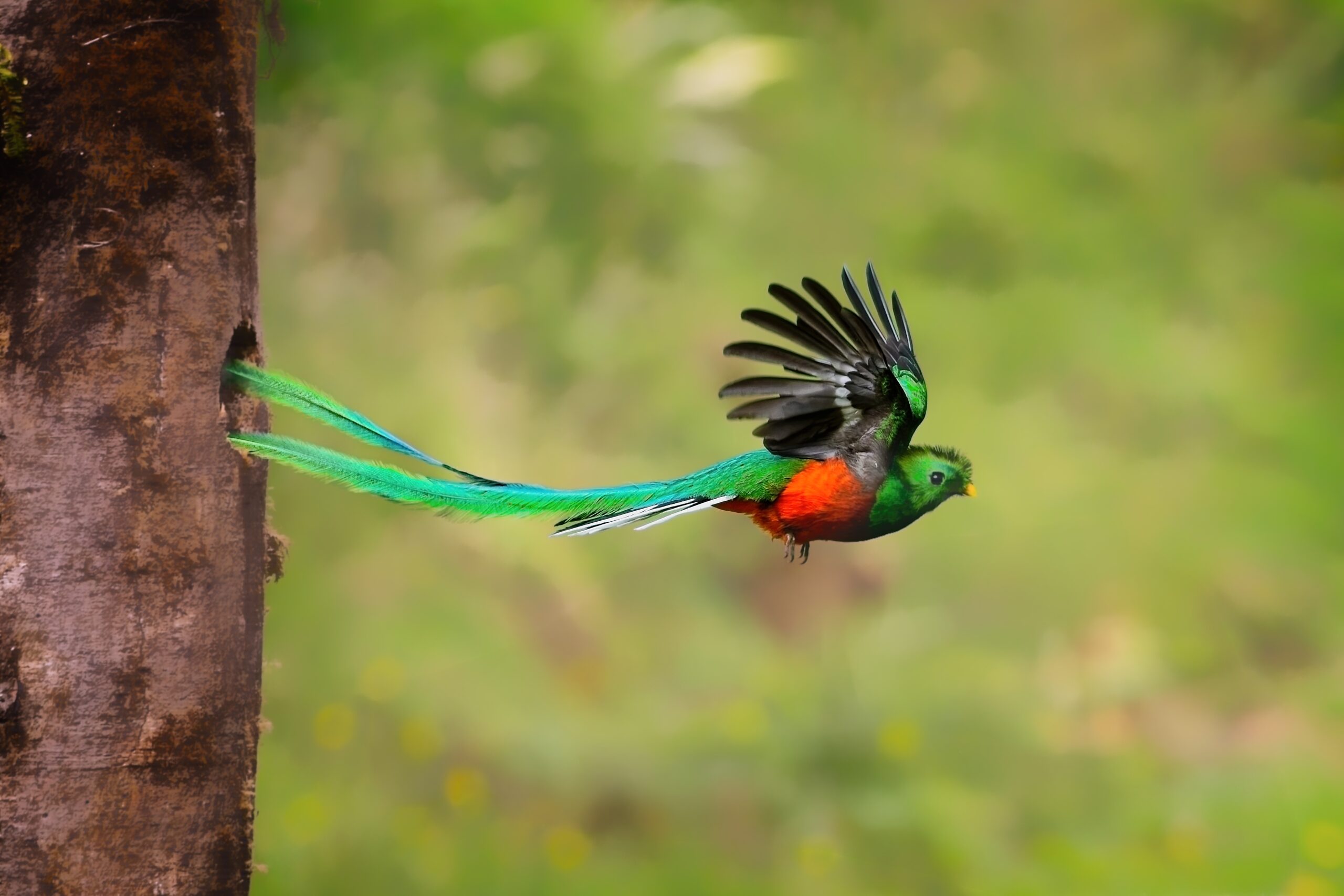
While the hotel is in a stunning location and my room was the most beautiful mountain setting of the entire trip, that is not what sets the hotel apart. What made this place completely memorable if not astonishing is their unique access to Quetzals. They have an arrangement with a farmer nearby, in an area popular with Quetzals. Eight years ago they set up a special nest for these extraordinary birds, in a tree trunk located around 30m from a small but simple viewing platform attached to the farmer’s house. Two baby chicks had hatched two days before we arrived and this was the perfect time to see these extraordinary and magnificent birds.
From the viewing platform you can see the ritual as the male or female Quetzals emerge from the hole in the trunk and fly off to forage for food. Both on the inward and outward journey and particularly for the male Resplendent Quetzal with its extraordinary tail feathers, there are unmatched opportunities for flight shots.
It’s by no means guaranteed and you might only get a couple of fleeting glimpses in a 2 hour session, but it is a world away from the zoo down in the valley. The first of the viewing sessions starts at 5:15 a.m., and runs to 7:30 a.m.. The second is at 8:30 a.m., and there is one more at 1:30 p.m.. This was such an incredible opportunity with such fleeting moments of extraordinary beauty, that I went on all three time slots.
The last one I did was the 8:30 a.m. slot, and this was my last ever bird photography experience in Costa Rica, at least on this trip. I was able to put all the learning I had got in the earlier two sessions to use and got some extraordinary images of these truly mystical birds in the last minutes of my tour. The feeling of elation and wonderment was overwhelming even for a cynical old coot like myself.
I cannot recommend this lodge and their sensitively managed, and ecologically sound Quetzal viewing experience enough. This alone is sufficient reason to come to Costa Rica in my view.
VII. FINAL TRANSITION & DEPARTURE (APRIL 1 – 3)
Logistics
- Drive from Paraiso Quetzal Lodge to ARANJUEZ LOFTS, and drop off luggage: 2 hours
Temp: 34/18 RH: 45%
- Car Return: Wednesday, April 1 @ 15:00 at SJO Airport.
- Uber back to hotel
Location 9: ARANJUEZ LOFTS, Santa Ana Río Oro, Santa Ana 10904
I wanted somewhere relatively peaceful for my last two nights to unwind, do some final culling of images, and to produce this commentary on the trip.
I didn’t particularly want to go to Escalante because I wanted a quiet and peaceful area with a nice pool. The Santa Ana district sounded the kind of thing I was looking for. I have to say that the area is not at all as fun or as sophisticated, or as accessible as Escalante. At least from where I was staying, it was a 15 to 20 minute walk everywhere, unlike Escalante where there are probably 30 restaurants, coffee bars or nightclubs within a 10-minute radius.
In Santa Ana a car is almost essential and I didn’t have one, expecting the accessibility of Escalante. The walkable restaurants near my hotel were either in or adjacent to a pretty unattractive development, and completely lacking in charm. The centre of Santa Ana is much more attractive and lively, but there are no hotels closer than a 15-minute walk away, and none of those are highly rated.
Having said all that, the place I stayed in, the Aranjuez Lofts (no lofts to be seen here) was without doubt the most beautiful and well-appointed of all the hotels I have been in in Costa Rica and it had a gorgeous pool. As a place to chill out and not move very far it was actually great, and I took a combination of Ubers and walking to get where I needed.
In the end I found a couple of excellent places to eat. The first was the Al Tapas Wine & Tapas | Gastrobar, which is in the strip development opposite the Hilton complex. It’s surprisingly authentic, with delicious tapas, including extremely good octopus. A couple of tapas with a very nice Rioja reserva were enough for me, followed by a glass of sweet PX with dessert.
For a last night’s blowout I went to Doris Metropolitan, an upscale, quite swish steak house in the centre of Santa Ana. Slight warning here. I didn’t find steaks to be particularly good anywhere in Costa Rica. They were either tough or undercooked or both and I can’t say I would bother in a future visit. I went because they had octopus on the menu and the octopus I ate in Costa Rica was some of the best I’ve ever had. I ordered the octopus appetizer and it was absolutely excellent and probably in the top three single dishes I had in Costa Rica.
As a second course I ordered a whole grilled red snapper. It arrived beautifully presented with some amazing sides on a huge wooden board and was completely raw. I have really never been served anything quite as badly cooked in any restaurant of this quality or indeed of any kind at all. I sent it back and it reappeared 15 minutes later, clearly the same piece of fish, now edible but obviously overcooked. If you want to go there I would advise having a couple of appetizers and a glass or two of their excellent wine. I still had a very enjoyable experience, the service was superb, and watching the superglams of Santa Ana arrive and dine was quite fun.
Flight Back: Friday April 3rd. SJO – Miami – London on American Airlines.
I booked on American via Miami because there was no availability on points with Iberia/BA via Madrid. Given the nightmare that Madrid turned out to be, I was reasonably happy about that, but the problem with Miami is that you have to immigrate into the US when transiting.
It didn’t look as though it would be a great experience. In times past I have waited hours in line in Miami immigration and TSA security checks, and that was when they were getting paid. I was distinctly nervous about the current situation, when TSA wasn’t being paid. I had allowed a 3.5 hour layover which I thought should be adequate but in the light of Madrid and the TSA problems I got an earlier flight which gave me a 5.5 hour layover.
In the end, the experience was absolutely excellent, although it wouldn’t necessarily work for everybody. There is a new USA immigration facility that is little known but available to all citizens including American ones. It’s called MPC (Mobile Passport Control) and details are provided here. Essentially, before you travel, you download an app on your phone, provide details, including a scan of your passport, and then wait until you arrive at your airport in the USA. On arrival (and I did this on the plane) you take a photo of yourself and provide a few more details. You then get directed to the MPC line which is usually almost deserted. I was through immigration in around 25 minutes which was a massive improvement on the giant line that the rest of the plane had to go through.
The reason I chose to travel BA, Iberia and American is that over my working life I travelled around 7.5 million miles on American Airlines and I am at Executive Platinum frequent flyer level for life. As a result, I can use first class facilities on all One World airlines. I hadn’t noticed before, but this provides a unique capability to skip the TSA security line. If you check in at first class they escort you to the front of the TSA line and you are through in minutes.
As a result, I immigrated into the USA and was back planeside in under an hour, which left me a long and actually quite pleasant interlude drinking Bolly in the American Flagship first class lounge (other than the foghorn voices of some of the lounge users).
I was in Premium Economy on the way back which was a pretty good experience. I didn’t need to eat, which was fortunate because the food looked pretty dreadful, but I slept reasonably well. The seat was identical to the business class seat I was in on the way from SJO to Miami, and a big improvement on coach. So overall a pretty good experience and I think I might use this route again.
Summary
I used Google Gemini and a number of other on-line resources like booking.com to plan the trip in around 2 days. Although there were ups and downs, the trip worked out nearly perfectly. The birding locations, hotels and driving routes (with the slight proviso of the crap room locations in some hotels) were exactly what I was hoping for. In addition, because of detailed research on temperatures and humidity etc, my clothes and other packing were appropriate for all the climate changes, and by and large the camera equipment was perfectly suited for the trip.
Travelling solo, without a guide and not being in a group was completely the right decision. I only had to talk to people that I liked (and the number of really nice people I met was a great pleasure and surprise to me) but I didn’t have to speak to people that I didn’t want to. I was able to make immediate decisions and deviate from the plan if something better came up, and I was able to eat and drink where I wanted. Not everybody wants to travel alone, but renting your own 4×4 and touring the country, either as a family or as a couple is completely the way to go.
And Costa Rica is absolutely lovely. I will certainly come back and I will certainly meet again some of the delightful people I encountered on the way.
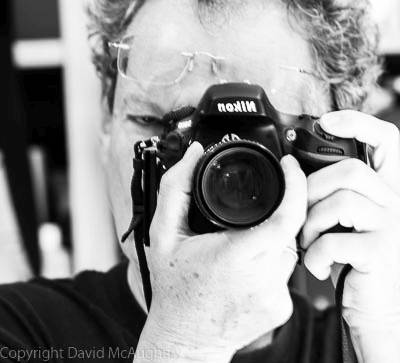
David McA — 2nd April 2026, Santa Ana / San Jose / Costa Rica.
SUMMARY OF KEY CONTACTS FOR WHATSAPP
- Sarapiquí Fixed-Hide Expert: José “Cope” Pérez (+506 8351 9081)
- Tarcoles Boat Captain: Cristian Quesada (+506 8831 2921)
- San Gerardo Photography Garden: Pippo at Batsu (+506 8851 6428)
- Sarapiquí Plumas & Picos: Luis (+506 8835 1520)
- Boca Tapada Lodge Manager: Adolfo (+506 2289 8163)
Gemini’s Pre-Trip Advice on Focal Lengths
Before the trip I used Google Gemini to research the best focal lengths for Costa Rican bird photography. The advice turned out to be largely accurate, so I’ve reproduced it here as a useful planning reference.
While having more reach is generally better for bird photography, the chances that you strictly need more than 800mm are relatively low for most of your planned stops. An effective focal length of 500mm to 600mm is considered the “sweet spot” for most Costa Rican birding.
When 800mm+ is Advantageous
- Tiny Target Species: Many targets (hummingbirds, honeycreepers, and small tanagers) are very small. In the open areas of Sarapiquí or Boca Tapada, an 800mm reach helps fill the frame without aggressive cropping.
- High Canopy Dwellers: Sloths, monkeys, and large birds like toucans often stay 30–80 feet up in the canopy.
- Shy Highland Species: In San Gerardo de Dota, getting close to a Resplendent Quetzal can be difficult due to terrain; having 800mm reach allows for tighter portraits from a distance.
Why 800mm+ Can Be a Hindrance
- Low Light Performance: Most 800mm+ setups (especially zooms or lens + teleconverter combos) have a smaller maximum aperture (e.g., f/8 or f/11). Under the dense forest canopy of Tirimbina or Arenal, you will likely need f/4 or f/5.6 to keep your ISO at manageable levels.
- Proximity at Feeders: At places like Cinchona (Hummingbird Café) and La Paz, birds often come within 5–15 feet of the balcony. At 800mm, you may find yourself “too close” to focus or unable to fit the entire bird in the frame.
- Weight and Mobility: Long walks on steep, muddy trails (especially in San Gerardo) make heavy, high-focal-length setups physically demanding to carry and stabilise.
| Location | Recommended Focal Length | Likelihood of Needing >800mm |
| La Paz / Cinchona | 100–400mm | Very Low (Birds are very close) |
| Sarapiquí / Tirimbina | 400–600mm | Moderate (For distant canopy shots) |
| Boca Tapada | 500–800mm | High (Large open spaces/distant raptors) |
| Arenal / La Fortuna | 400–600mm | Moderate (Mixed open and dense forest) |
| San Gerardo de Dota | 600–800mm | High (Distance required for Quetzals) |
Focus Keyphrase: Costa Rica bird photography Meta Title: Costa Rica Bird Photography: A 3-Week Field Guide (2026) Meta Description: A photographer’s first-hand account of three weeks bird photography in Costa Rica — lodges, guides, hidden locations, restaurant finds, and practical tips for solo travel with a 4×4. Canonical URL: (set to post URL once published) Open Graph Title: Costa Rica Bird Photography: A 3-Week Field Guide (2026) Open Graph Description: From Sarapiquí hummingbirds to a Resplendent Quetzal nest at Paraiso Quetzal Lodge — a detailed, opinionated account of what worked, what didn’t, and who to call. Schema Type: Article

