Giant OM1 I and II spreadsheets of my top photo settings

OM System cameras are among the most configurable cameras available, with somewhere between 400 and 500 individual menu settings on the OM-1 series alone. When you add four independent custom settings configurations, the number of potentially stored settings rises to around 2,000. Recording all of those in a form you can actually read — and understanding which ones you changed and why — turns out to be a surprisingly difficult problem.
This post presents the solution: a pair of giant spreadsheets, one for the OM-1 Mark I and one for the OM-1 Mark II, that systematically list every menu item with my settings and the reasoning behind every non-default choice. The Mk II version has recently been updated by a reader, MM, who has added links to the relevant pages in the OM-1 Mark II User Guide — making it, I believe, the most complete OM-1 Mk II settings reference available anywhere.
If you would rather head straight to a concise summary, the TL;DR is at the foot of the page — or jump directly to the FAQ.
The forest of OM menu items
OM System (previously Olympus) cameras are enormously configurable, particularly the EM1, OM-1, EM5 and OM-5 ranges. Including sub-menu options, there are between 400 and 500 different settings available in these cameras. They also allow the saving of up to four independent menu configurations in custom settings, which means that there could be up to 2,000 different menu settings stored. In reality, only a small subset of menu items are typically changed between, say, a landscape configuration and a street configuration. It is genuinely enjoyable tuning these settings to get the camera exactly to your liking. The problem comes when you change cameras.
Menu backup and camera migration

All the EM and OM series cameras allow their settings to be saved to a phone or computer. This is enormously helpful as a backup, but there are two significant limitations. First, the saved file is unreadable — you cannot open it and see what the settings actually were. Second, the file can only be restored to an identical camera model. So if you replace a broken OM-1, the backup is perfect. But if you move from an EM-1 to an OM-1, or from an OM-1 Mark I to an OM-1 Mark II, you cannot transfer the settings at all.
It is at this point, after buying a new OM camera, that you realise there are 400–500 settings and you cannot remember which ones you changed, let alone why. This happened to me. After two years with the OM-1 Mark I, I acquired an OM-1 Mark II and wanted it set up identically. The only way to achieve this was to go through every setting on the Mark I, note them all down — including all four custom setting configurations — and then transfer them manually to the Mark II. It was a considerable amount of work, and I was determined not to lose the result.
The spreadsheets — origin and development
There is very little on the internet that systematically lists all the menu items on OM cameras. There are innumerable YouTube videos, some of which are quite helpful, and many blog posts, but none of them contain every menu item written down in a single structured document.
In fact, only one person has done this — as far as I know — and I am hugely indebted to him. This is the meticulous BobCS, who in 2022 posted a link to an OM-1 spreadsheet on DPReview. Just in terms of spreadsheet construction alone, this is a masterpiece. Bob included the actual OM-1 menu icons in his work, and even provided a link to the relevant page of the User Guide for every single setting. Bob does not appear to be active on DPReview any more, and this may have been his only post there — but what a contribution to leave behind.
At the time Bob created it, he had just bought his OM-1, so his settings were largely tentative. But his framework provided a magnificent base on which I have since entered all of my settings over three years of shooting and testing. I made a few structural changes — moving some less relevant page tabs to the end of the workbook, for example — but the main additions were to fully populate all four custom settings configurations, and to add a column explaining the reasoning behind every non-default choice.
The menu system on the OM-1 Mark I and the OM-1 Mark II are 99% identical, but OM System changed the menu numbering from the point at which the menus diverge — which creates a problem for anyone trying to adapt the Mark I spreadsheet for the Mark II. I created the Mark II variant myself and, as far as I know, it remains the only one available on the internet. I confess I did not update Bob’s User Guide reference links for the Mark II version, as I rarely use the manual myself and was initially doing this for my own purposes only.
That gap has now been filled by a reader, MM, who had a Mark II and kindly took the time to add the User Guide page references throughout the Mk II spreadsheet. The updated version, incorporating MM’s work, is the file linked below. My thanks to MM for a genuinely useful contribution.
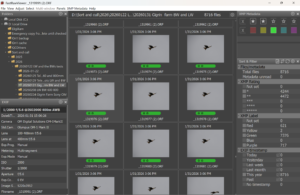
I show an example of the “gear” options tab on the spreadsheet in the image below. Click to view full size, but the actual sheets are linked below.

Download the spreadsheets
Both spreadsheets are free to download and adapt. As I am confident BobCS intended his work to be widely used, I offer mine in the same spirit.
How to use the spreadsheets
The spreadsheets are designed as a framework for recording your own settings, with my settings provided as a worked example. Even if you disagree with some of my choices — and you may well, since a great deal depends on shooting style and subject matter — the reasoning column should at least prompt you to think about why you have your settings the way they are, and whether they are actually doing what you intend. The menu system on these cameras is deep enough that it is entirely possible to have settings active that you set years ago and have since forgotten about.
One important clarification: the spreadsheets record menu values only. They are a reference document, not a tool for directly applying settings to a camera. If you want to replicate my settings exactly and load them directly onto your camera, the OM System uses a proprietary binary .set format for that purpose. I provide downloadable .set files, along with a condensed cheat sheet for the most important settings, in the related posts below.
TL;DR
- OM System cameras have 400–500 menu settings; the native settings backup file is unreadable and cannot be transferred between different camera models, even between the OM-1 Mark I and Mark II.
- These spreadsheets are the only structured templates on the internet that mirror the full OM-1 menu system — they are designed as a framework for you to record your own settings, with my settings provided as a worked example.
- The OM-1 Mk I spreadsheet is based on the original work of BobCS, who posted it to DPReview in 2022. The Mk II version was created by DMcA to cover the divergent menu numbering of the Mark II, and has recently been updated by reader MM with full User Guide page references.
- The spreadsheets record menu values only — they cannot be used to directly apply settings to a camera. For downloadable camera settings files (.set format), see the linked posts below.
- Both spreadsheets are free to use and adapt under the same spirit in which BobCS originally shared his work.
Frequently asked questions
Why can’t I just use the OM System settings backup to transfer my settings to a new camera?
The OM System backup file — saved via the OI.Share app or directly to a card — is a proprietary binary format that cannot be read or edited. More critically, it can only be restored to the exact same camera model. Moving from an OM-1 Mark I to a Mark II, or from any EM-series body to an OM-series body, means starting from scratch. The spreadsheet exists precisely to solve this problem by giving you a readable record you can work from manually.
Is the spreadsheet just your settings, or can I use it for my own?
The spreadsheet is primarily a template — a structured framework that mirrors the full OM-1 menu system. My settings are a worked example. You can overwrite them with your own values, add your own notes to the reasoning column, and adapt the structure however you like. That is exactly what BobCS intended when he created the original, and what I intend in sharing my version.
Why are the OM-1 Mark I and Mark II spreadsheets separate files rather than a single combined sheet?
The two cameras share approximately 99% of their menu structure, but OM System changed the menu numbering from the point at which the menus diverge between the two models. This makes a single combined sheet impractical — the page references and menu numbers would conflict. The cleanest solution is two separate files, each accurately reflecting its own camera’s menu structure.
The spreadsheet shows your settings — but are they still current?
Broadly, yes. The settings reflect three years of shooting and testing with the OM-1 series and are updated periodically. That said, some settings are subject matter dependent — my birds-in-flight configuration differs from my landscape configuration — and optimal choices can shift as OM System releases firmware updates. The reasoning column is arguably more useful than the settings themselves, as it explains the logic rather than just the value.
Can I load the spreadsheet settings directly onto my camera?
No — the spreadsheet is a reference document, not a camera file. The OM System uses a proprietary .set binary format for direct settings transfer. I provide downloadable .set files for specific shooting scenarios in the related posts below. The spreadsheet and the .set files serve different purposes: the spreadsheet gives you a complete readable record of every menu item; the .set file lets you load a specific configuration directly onto the camera in seconds.
Is there an equivalent spreadsheet for the OM-3?
Yes — I have produced a separate spreadsheet for the OM-3, which has a very similar menu structure. It is available at the link in the related posts below.