Resolution of OM vs Sony wildlife zooms
In a previous post, I showed the results of testing focus accuracy for the Olympus Pro zooms and the two main Sony Wildlife zooms. The focus accuracy for all systems was excellent at over 90%, but the OM 50-200 f2.8 with the MC20 teleconverter produced the highest accuracy for a practical bird-in-flight lens.
A key question that remains is: it may be accurate, but is it sharp? Surely any lens with a 2x teleconverter attached cannot produce sharp images. I wanted to find out, so I tested the absolute resolution of OM vs Sony zooms. I show the results in this post.
If you would rather head straight to a concise summary, the TL;DR is at the foot of the page — or jump directly to the FAQ.
The test chart setup
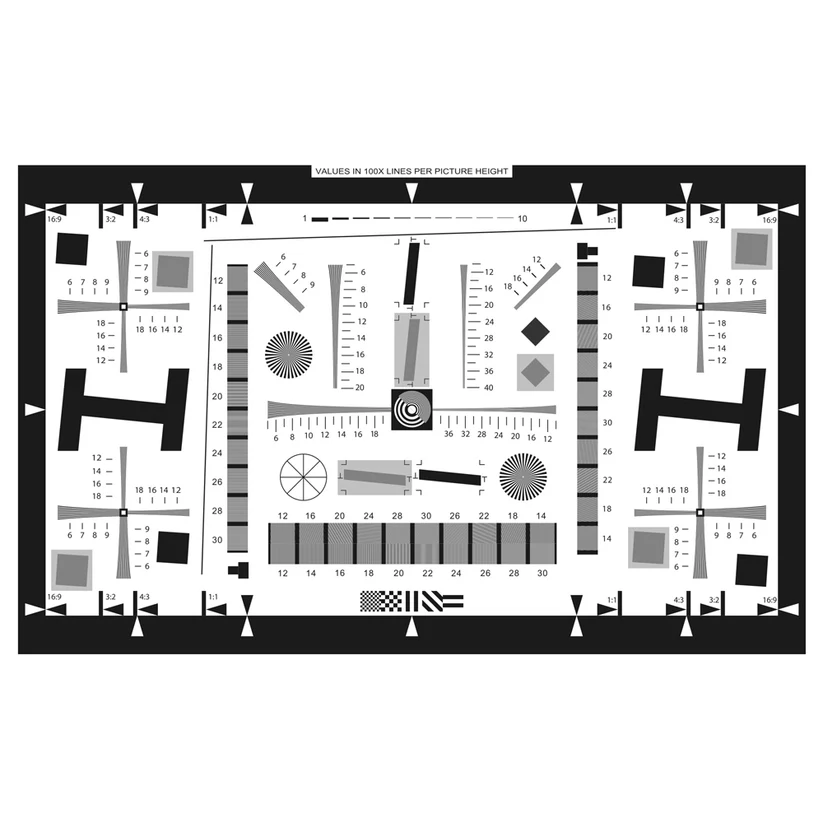
Spatial Frequency Response (SFR) testing uses a dark edge against a light background to measure resolution. The standard for doing this for camera lenses is ISO 12233. The original ISO 12233 test chart has a resolution of up to 2000 line pairs per picture height, and I have used this in the past. For this testing, I bought the 4x Enhanced Resolution Test Chart (765x475mm) from Cinegear Pro, which has a resolution of up to 4000 line pairs per picture height. As will be seen, this was an absolute requirement.
Practically, this method tests the ability to resolve very fine sets of parallel lines on a test chart. The test chart is shown in the featured image above. The test measures system-level performance, i.e., the lens + sensor combination. This is an important point, as will be noted later.
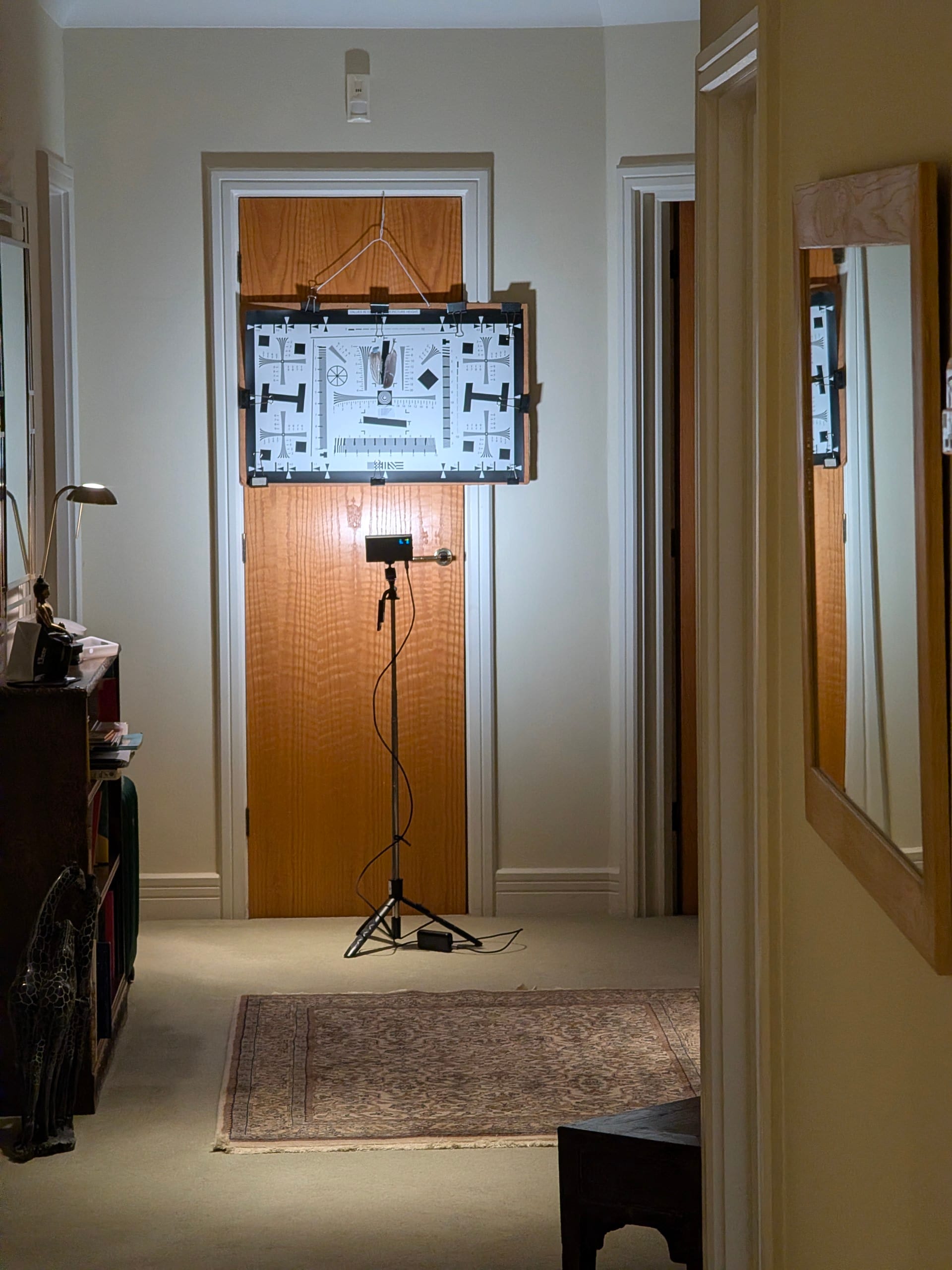
The chart is mounted on hardboard to keep it flat, and illuminated by a constant LED light source, as shown in this picture. Most commercial test setups are in a normal-sized room, and as a result, they can not properly measure the resolving power of long telephoto lenses. My setup uses the entire length of my apartment, plus the outside lobby, and I can measure from up to 20m away from the test chart. While there are a small number of test setups that can do this, particularly Bryan Carnathan of the Digital Picture, none, as far as I am aware, have compared Sony vs OM wildlife zooms (Bryan has not tested OM or Olympus lenses).
Scaling the Standard — 1X, 4X, and 8X Charts
To understand why my test methodology is comparable to industry-leading lab tests, such as those at the Digital Picture, we have to look at how a resolution chart scales with distance.
The standard ISO 12233 (1X) chart is designed for close-range testing. However, at long wildlife distances, a 1X chart becomes so small in the frame that the sensor’s pixels are larger than the lines on the chart, making it impossible to measure the lens’s true performance.
To solve this, Enhanced/Scaled Charts are used. The common sizes are:
- 1X (Standard): Used for wide-angle or very close-range testing.
- 4X (My Standard): My chart is four times the size of the standard. This allows me to move the camera back to 18 meters while still filling the frame. This is the “sweet spot” for wildlife photography, as it tests the lens at a realistic working distance while maintaining enough detail for the sensor to “see” the lens’s limits.
- 8X (Digital Picture Standard): Bryan often uses a massive 8X chart. Because his chart is twice as large as mine, he can achieve the same “Constant Framing” at even greater distances—or, more commonly, he uses that extra detail to ensure the lens is the bottleneck, not the sensor.
System setup
The systems tested were as follows:
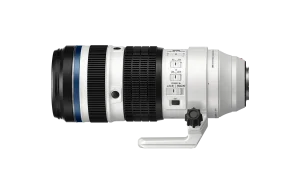
OM System: I tested the M.Zuiko 50-200mm f2.8 IS PRO + MC20 (yielding an 800mm FFE f5.6) and the M.Zuiko 150-400mm f4.5 (300-800mm FFE) TC1.25X IS PRO with the OM1 MkII.
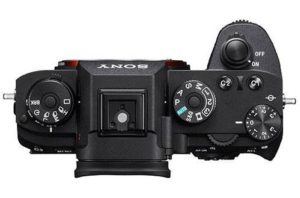
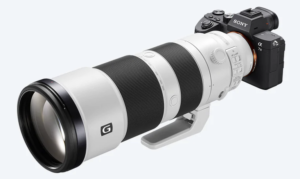
Sony System: I tested the FE 200-600mm f5.6-6.3 G OSS and the newly released FE 400-800mm f6.3-8 G OSS. with the new A7V.
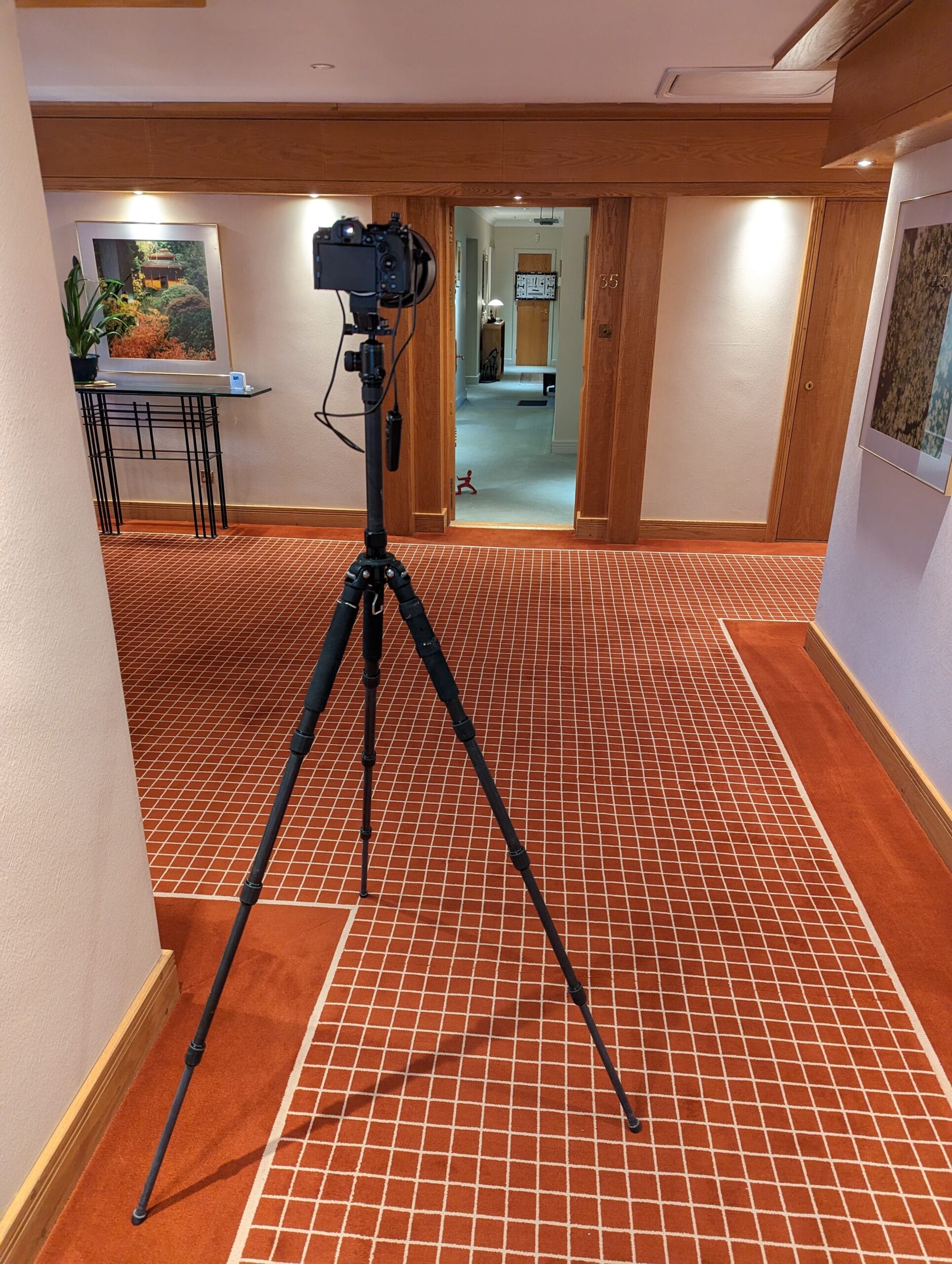
For both systems, the lenses were mounted (via the lens foot) on a Benro indexing head on a solid (Feisol) tripod. The centre of the lens was set at the height of the centre of the test chart.
For each focal length, I set up the camera so that the test chart filled the frame. At 800mm FFE focal length, this was around 18m from the chart, reducing proportionally as the focal length reduced. Both cameras were set at base ISO, and the shutter speed was adjusted so that dark under-exposed areas were just appearing and there were no over-exposed areas (typically =1.3-1.7 EV). Speeds were typically 1/10th of a second. The lenses were tested wide open, as they would be used for almost all bird in flight photography.
The images were taken in JPG to minimise any differential effects of RAW sharpening, and remote shutter release was used in both cases, using the Olympus RM-WR1 Bluetooth shutter for the OM1, and the (dreadful) Sony Creator’s App for the A7V. In each case, I fired a burst of up to 10 images, and selected the sharpest for evaluation.
The Methodology: Visual Extinction and the MTF0 Limit
To quantify the absolute resolving power of these systems, my evaluation relies on the principle of Visual Extinction Resolution. While laboratory tests often focus on MTF50 (the spatial frequency where contrast drops to 50%) to measure “perceived sharpness,” my field tests identify the MTF0 limit—the cut-off frequency where the lens can no longer transfer any modulation. Using the ISO 12233 hyperbolic wedges, I identify the point where the black and white lines merge into a solid gray mass, representing the absolute limit of the system’s resolving power. By benchmarking this “extinction point” across different systems, I am measuring Realized Resolution—the final threshold of detail that the human eye can extract from a file before aliasing and diffraction render it invisible.
In my view, this is the most honest way to test wildlife lenses because it mimics how we perceive fine details, like the barbules on a bird’s feather, which are either visible or “extinguished” into a blur. MTF50 is great for measuring how “crisp” an image looks (sharpness), but it doesn’t tell you the absolute limit of detail. MTF0/Visual Extinction tells you exactly when the lens “gives up.”
Evaluation of test images
My only interest here is centre resolution. For birds in flight, the bird is invariably at the centre or close to it. Other factors, such as edge resolution or astigmatism, are important for landscape or product photography but not of much interest for BIF.
To measure the resolution, I used the line pairs just to the right of centre, which, as noted, can measure a resolution of up to 4000 line pairs per picture height. This corresponds to “position 1” in the Digital Picture test images. I did not normalise the camera resolutions – so the full resolution of the 33MPx Sony A7V was measured against the full resolution of the 20 Mpx OM1 Mk II.
The limit of resolution was quite easy to see for all systems – resolvable lines turn unresolvable over a fairly clear boundary. Although these are not MTF tests, 2500 lpi = 50 line pairs/mm .
The results: OM vs Sony wildlife zoom resolution compared
| Brand | Lens | 300mm FFE | 600mm FFE | 800mm FFE | Comment |
|---|---|---|---|---|---|
| Sony | 200-600 | 31 | 26 | 21 | Crop at 800mm |
| Sony | 400-800 | — | 32 | 31 | Benchmark |
| OM | 50-200 MC20 | — | 24 | 23 | Out-resolves Sony Crop |
| OM | 150-400 | — | 24 | 23 | Pro Zoom |
| OM | 50-200 | 25 | — | — | Bare Lens |
| OM | 50-200 THR | 33 | — | — | 80MP High Res Mode |
Table 1: Visual Extinction limits measured in 100s of lpi using an ISO 12233 4x test chart at 18m. The Sony A7V (33MPx) was used for Sony lenses; the OM1 Mk II (20MPx) for OM lenses. All lenses tested wide open at base ISO.
At 600mm, the Sony 400-800m was well clear of the field at an excellent 32 lpi resolution. The Sony 200-600, the OM 50-200/MC20 and the OM 150-400 were very close at between 24-26 lpi.
At 800mm the 400-800 again out-resolved the other lenses at 31 lpi. However, here the 200-600 fell behind the other two as the image had to be cropped to fill the frame, reducing resolution as expected. The tiny 50-200/MC20 combination outresolved the 200-600 and equalled the 150-400, a performance which may amaze some, but which is entirely consistent with the tens of thousands of images I have taken with the lens.
Just for the heck of it, I also tested the OM1 in 80Mpx tripod HIRES mode with the 50-200 (no MC20) and at 300mm FFE. It outresolved the Sony A7V and the 400-800 with an amazing 33 lpi resolution. Of course, a higher resolution camera, such as the 61 MPx A7R5 could probably beat this result, but it is an indicator of the amazing quality of the little 50-200 and the 20Mpx OM1 sensor.
The limits of resolution
It is worth putting the lines per inch numbers in perspective. My chart allows testing up to 4000 line pairs per picture height. On the chart, at that level, the lines are around 200 microns thick. I cannot with my own eyes resolve individual lines at greater than around the 25 marker, even inches away from it. To put it another way, the LW/MC20 combination resolves detail from 60ft away, which is at the limit of what I can physically see. even when close up. The 400-800 from 60 ft away resolves detail that is unseeable close up.
This level of detail is finer than the feathers or any other detail on a bird. So the question arises, how much resolution is enough? There is literally no detail on the bird that is small enough to need the highest levels of resolution on this test. If, for some reason, you were using the lens as a microscope from 60 ft away, there might be some benefit. But we are looking at birds and wildlife, not grains of sand.
There is clearly a point at which you have a resolution capability that is greater than needed. I would say anything beyond a 2,000-2,500 lpi resolution on my test is that point.
One might argue that you might need a higher resolution if you were cropping in. Not so. It is only possible to evaluate the tests at insane crop levels—typically 300%. The uncropped image is shown in the featured image at the top. In a normal view, you can’t even tell there are lines, let alone 4,000 per inch.
So I would contend that the extra resolving power of very high-resolution long telephoto lenses is largely wasted. It’s also why a cheaper wildlife lens like the Panasonic 100-300 (200-600 FFE) often seems to produce photographs just as attractive as the more expensive zooms.
Commentary
The Sony 400-800mm lens is a magnificent piece of glass in terms of speed, image quality, and resolution. Sadly, however, it is more than double the weight of the 50-200/MC20 combination, and unusable for me as a bird-in-flight lens. Moreover, it is too big and too long to double as a landscape lens, so unless weight and size are no object (unusual for any overseas photo trip), it’s not an option for me.
The Sony 200-600 is a nice, if heavy, lens, but with the A7V, it is outperformed in focus accuracy and in resolution at the long end by both OM lenses.
The clear standout winner for me is the 50-200/MC20. It’s extremely sharp, extremely fast, extremely accurate and extremely light. It’s also weatherproofed, makes a superb landscape lens and with the MC20 is a full 2:1 FFE macro lens with a minimum focus distance of 78cm.
There is nothing to touch this amazing optic from any manufacturer at any price. So for the time being, (possibly until Sony puts the 400-800 technology into the 200-600 lens), I will stay with the Little White.
Tech note 1: effect of the MC20
Sony glass users will probably not find much to complain about in these data, particularly in the outstanding characteristics of the 400-800.
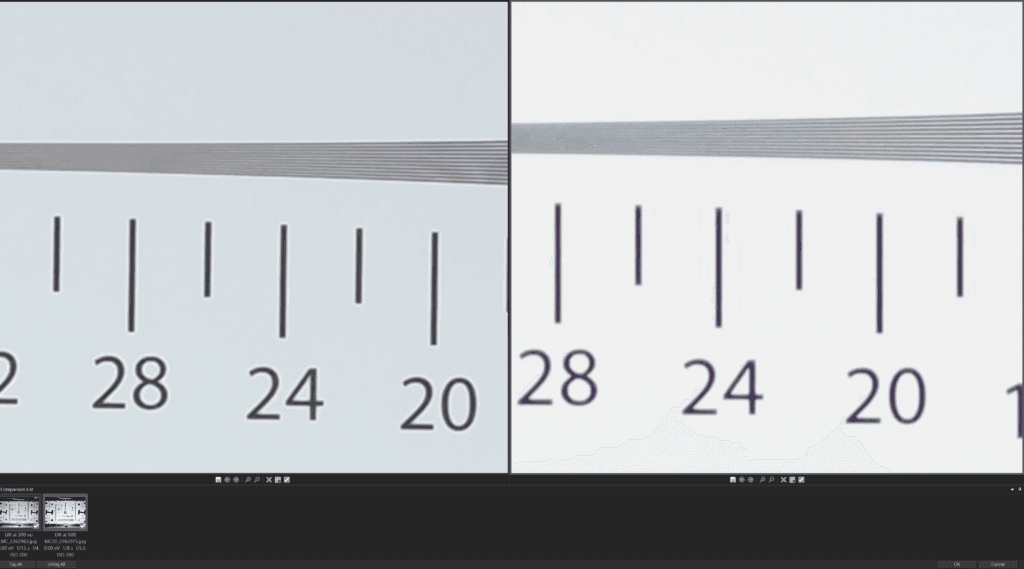
OM users, wedded to the idea that the MC20 degrades image quality, might be sceptical about some of the data. In particular, the astonishing result that the 50-200/MC20 at 800mm FFE only loses one unit of measurement compared to the bare lens at 300mm FFE. I can assure you that this result is correct. Overall, the bare lens at 300 is a hair sharper, and the contrast is better. But the resolution is almost identical. I show the massively enlarged JPGs below (click to enlarge), and you will see there is no camera shake in either image, and the lines (at about 24=2400 lines per inch) show a very similar transition. The MC20 is on the right.
It’s worth also noting that when given a higher resolution recording medium in the HiRes mode, the 50-200 has even greater reserves of sharpness, which augurs well for the future.
Tech note 2: The Resolution Gap: Lab Potential vs. Field Reality
In lab reports like The-Digital-Picture, almost all the lenses tested appear to clear 4000+ lpi with ease. My tests show the Sony and OM lenses failing at lower line resolutions. This is because Industry lab tests utilise 61MP sensors (like the Sony A7R IV) and massive 8X charts. These are designed to show the Optical Potential—the theoretical ceiling of the glass in a vacuum. Because the chart is so large, it provides high “input contrast,” showing headroom that may never be realised on a standard sensor.
My tests measure System Resolution. On a 33MPx sensor (Sony A7V), the physical grid of pixels acts as a natural ceiling (the Nyquist limit). While a lab shows what a lens could do on a 100MPx body, my results show the Realised Resolution you will actually see in your files at 18 meters.
When my data shows the OM system out-resolving the cropped Sony at 800mm FFE (23 vs 21), that represents a tangible, visible difference in feather detail you will witness in your actual wildlife photography.
Tech note 3: Copy variation and Perceptual Parity
Roger Cicala of Lens Rentals is an expert on copy variation. He is one of the few people in the world who gets to test multiple copies of lenses from the major manufacturers. Here is a distillation of his conclusions as they affect zoom and prime lenses.
- Bad copies are rare. His statistics suggest you’d need to buy over 50 lenses to get a single bad one.
- Copy variation is very common. It is almost inevitable, given how complex lenses are.
- Zooms vary more than primes in general, and they vary at different focal lengths. So you are unlikely to get a bad copy of a Zoom, but you are quite likely to get copies of a given Zoom that have different characteristics at different focal lengths.
- To put this another way, you are unlikely to get a zoom lens copy that is better at every focal length than other copies. It will just be better at some points and worse at others.
- This may be why I got unexpectedly stellar results from my copy of the 400-800 at the long end. There is a wide disparity of views about how sharp this lens is – with Sony saying it’s significantly sharper than the 200-600, and some others saying there is little difference.
TL;DR
Yes, the OM 50-200mm f2.8 with MC20 teleconverter is very sharp. Using ISO 12233 resolution testing at realistic wildlife distances (18 metres), I measured the visual extinction resolution of four wildlife zoom systems. At the critical 800mm full-frame-equivalent focal length:
- The Sony 400-800mm f6.3-8 on the A7V delivered the highest absolute resolution at 3100 lpi — an outstanding result, but the lens weighs 2.5kg and is impractical for handheld bird-in-flight work.
- The OM 50-200mm f2.8 + MC20 on the OM1 Mk II achieved 2300 lpi — matching the far more expensive OM 150-400mm f4.5 TC, and out-resolving the Sony 200-600mm (2100 lpi when cropped to 800mm).
- The tiny 50-200/MC20 combination weighs 1.2kg, less than half the Sony 400-800, and loses only one unit of resolution at 800mm FFE compared to the bare lens at 300mm FFE — a remarkable result for a 2x teleconverter.
- In practical terms, all four systems resolve detail finer than any feature on a bird. The resolution differences between them are only visible at extreme crop levels (300%+), meaning the OM system’s weight and handling advantages may matter more than the Sony’s resolution lead for most wildlife photographers.
Frequently asked questions
Why does the Sony 200-600 perform worse at 800mm than the OM 50-200 with MC20?
The Sony 200-600 cannot optically reach 800mm — to fill the frame at that focal length you must crop the image in post. Cropping reduces the effective sensor area and therefore the resolution. The OM 50-200 with MC20 achieves 800mm optically, so the full 20MPx sensor is used. At 800mm the cropped Sony resolves 21 units vs 23 for the OM — a visible difference that appears at aggressive crop levels.
What is Visual Extinction and why use it rather than MTF50?
MTF50 measures the spatial frequency at which contrast drops to 50% — a useful measure of perceived sharpness. Visual Extinction (MTF0) identifies the point at which the lines on a test chart merge entirely into grey — the absolute resolution limit. For wildlife photography, where you want to know the finest feather detail a lens can render, MTF0 is more informative than MTF50 because it tells you exactly when the lens runs out of resolving power rather than when it starts to look soft.
How does your test setup compare to lab tests like The-Digital-Picture?
The Digital Picture uses an 8X chart on a 61MP sensor designed to reveal Optical Potential — the theoretical maximum of the glass with the sensor as a non-limiting factor. My setup uses a 4X chart at 18m on a 33MP or 20MP sensor, measuring System Resolution — what you actually get in your files at a realistic wildlife working distance. The lab approach shows what a lens could do on a future 100MP body; my approach shows what it does on the camera you’re actually shooting with.
Is the OM1 80MP High Resolution mode useful for wildlife?
Only on a tripod with a static subject — the mode requires multiple exposures and is unusable for anything that moves. But as a demonstration of the 50-200’s optical quality, the result is striking: in HR mode at 300mm FFE it outresolves the Sony A7V and the 400-800 at 33 units vs 31 and 32 respectively. It confirms that the lens has resolution reserves well beyond what the standard 20MP sensor can capture.
Does copy variation mean your results might not apply to my copy of the lens?
Possibly at the margins. Roger Cicala’s extensive testing at LensRentals shows that bad copies are very rare — statistically you would need to buy over 50 lenses to encounter one. However, zoom lenses routinely vary between focal lengths, so a copy might be sharper at the long end and slightly softer in the middle, or vice versa. The outstanding result I measured for the 400-800 at 800mm may partly reflect a particularly good copy at that focal length, though the results are consistent with what others have found.
Related Posts — OM vs Sony Series
Resolution
OM vs Sony Wildlife Zooms: Resolution Shootout
Focus Accuracy
Focus Accuracy Shootout: OM-1 II vs Sony A7V
Dynamic Range & Noise
Dynamic Range and Low-Light Noise: OM vs Sony
Lens Handling
OM and Sony Wildlife Zooms: Lens Handling
Zooms vs Prime
Sony Wildlife Zooms vs the 600mm f4 GMaster Prime
2026 Summary
OM and Sony Wildlife Zooms: 2026 Summary
Teleconverters & Focus
OM Pro Zooms: Effect of Teleconverters, ISO and Background on Focus Accuracy