Dynamic Range and low-light noise – Sony vs OM zooms
In previous posts, I have compared the focus accuracy and resolution of the Sony A7V and the two Sony wildlife Zooms, with the OM1 mk II and the two OM wildlife Pro Zooms. These have shown that the OM system gives little away to the bigger full-frame systems, particularly when weight and size are considered.
The other key factor is the effect of the sensor on image quality. In this post, I compare the dynamic range and low-light noise of the Sony vs OM zooms when paired with their respective cameras.
If you would rather head straight to a concise summary, the TL;DR is at the foot of the page — or jump directly to the FAQ.
Camera Dynamic range comparison
Dynamic range (DR) and low light noise (LLN) testing is complex, tedious and requires special equipment and/or analysis techniques. I don’t have the time or resources to do it, and in the world of AI denoise, it is no longer a priority for me. However, for many photographers, sensor performance is the elephant in the room when considering OM systems for wildlife.
The ISO problem
Both DR and LLN values decline as the ISO increases, so the ISO value is an integral part of the results. However, almost all camera manufacturers overstate the ISO value, so in any given situation, the real ISO is less than the ISO being shown on the camera. Both Sony and OM do this to varying degrees. This makes comparing DR and LLN values difficult unless each camera’s real ISO values are taken into account.
Data sources and the ISO problem
There is only one source of DR and LLN data that accounts for ISO variance: the comparative charts produced by DxO Labs.
For every camera, DxO measured the real ISO vs manufacturer’s ISO, and for their DR and LLN measurements, used the real ISO. The data were thus truly comparable across multiple manufacturers. The other benefit of DxO was that they produced a true LLN figure by measuring Signal to Noise Ratio (SNR) across a range of true ISOs.
Unfortunately, since the success of the DxO PhotoLab and PureRaw post-processing software, DxO has ceased testing new cameras, although data for prior tests is still accessible. It is possible to get a good proxy for the OM1 and A7V by looking at the data for the EM1 MK II (also 20Mpx) and the A7RV/A7R4 (full-frame cameras with very similar sensor technology), so let’s look at those.
DxO data
The DxO curves for DR plotted against true ISO are shown below. You can get an enlarged view of the plot by clicking on it.
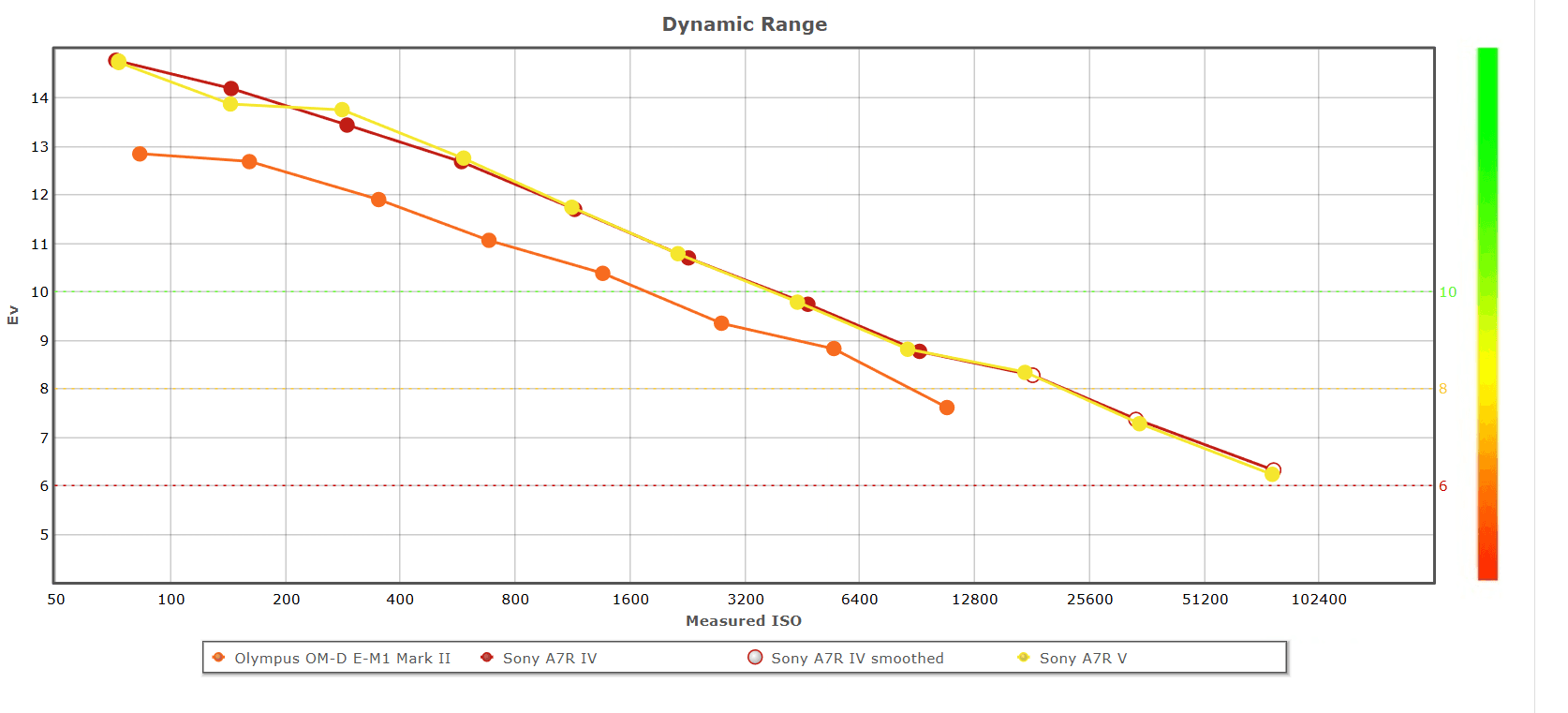
You can see that the curves are mostly parallel, so as a single data point, I will refer to ISO 3200, which is the level at which noise and DR start to become an issue in bird photography. You can see that the DR for the Sony cameras is 1 stop greater than that for the EM-1 Mk II.
Now here are the DxO curves for the signal-to-noise ratio (SNR) measured at 18% grey.
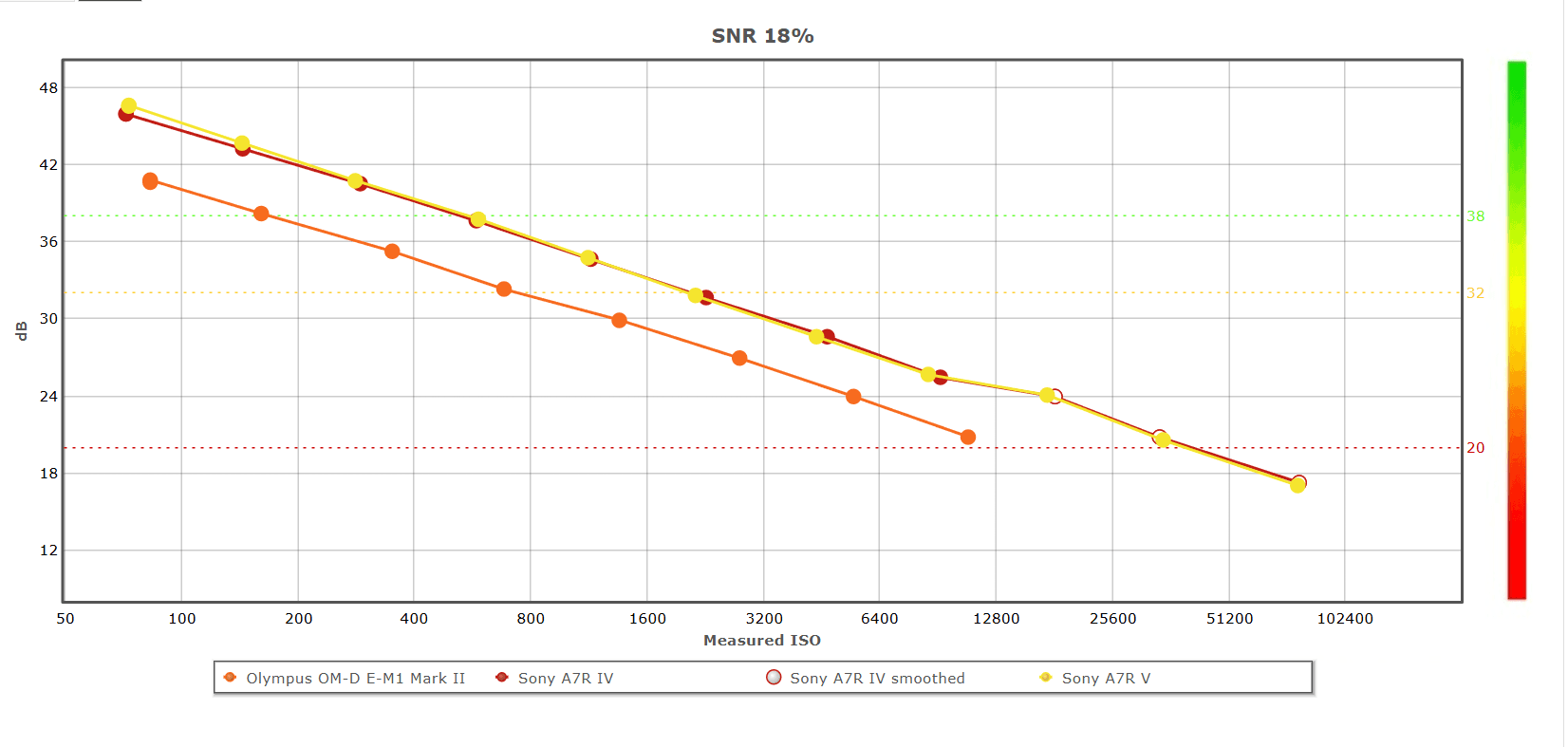
Once again, we will look at the data at a true 3200 ISO. Here, the Sony cameras have an SNR that is around 2/3 stop (in this log scale 6dB = 1 stop) greater than the Olympus.
The effect of faster OM lenses
The advantage of the Sony full-frame sensors is largely cancelled out by the fast OM Pro Zoom lenses. For example, at 600mm, the 50-200 OM plus MC14 is at f4, compared to the 200-600 Sony at f6.3. The difference is 1.3 stops, cancelling out the Sony sensor advantage and rendering the DR about the same.
Across other lenses and other focal lengths, the DR is a wash, due to the opposing effects of faster OM lenses and the larger Sony sensor. Even the worst comparison, the 50-200 /MC20 at f5.6 vs the 200-600 f6.3 results in a net noise advantage to the Sony of under half a stop.
Net net, there is almost no difference in DR or noise between the two systems at 600-800mm FFE when using the premier wildlife zooms.
The double penalty of cropping the Sony 200-600 to 800mm
There is a further point that is almost never discussed. The Sony 200-600mm lens cannot optically reach 800mm — to get there, you must crop the image in post-processing. This means you are no longer using the full area of the 33MPx sensor. The cropped region is approximately APS-C sized, and APS-C sensors have lower dynamic range than full-frame sensors, because fewer photons are captured per unit area. So at 800mm, the 200-600 suffers a double penalty: it loses resolution (as I showed in my resolution tests) and it loses the full-frame dynamic range advantage that is supposed to be the whole point of choosing a bigger sensor. This makes the 200-600 at 800mm a significantly weaker proposition against the OM system than the raw sensor specifications would suggest.
| Focal length (FFE) | OM Lens | OM aperture | Sony Lens | Sony aperture | Lens speed advantage (OM) | Sony sensor DR advantage | Net DR difference |
|---|---|---|---|---|---|---|---|
| 600mm | 50-200 + MC14 | f4 | 200-600 | f6.3 | +1.3 stops | ~1 stop | +0.3 OM |
| 800mm | 150-400 (BW) | f4.5 | 400-800 | f8 | +1.7 stops | ~1 stop | +0.7 OM |
| 800mm | 50-200 + MC20 (LW) | f5.6 | 400-800 | f8 | +1.0 stop | ~1 stop | Equal |
| 800mm* | 50-200 + MC20 (LW) | f5.6 | 200-600 (crop) | f6.3 | +0.3 stops | Reduced* | OM ahead* |
* The Sony 200-600 must be cropped to reach 800mm FFE, reducing the active sensor area to approximately APS-C size. In crop mode, the Sony loses its full-frame sensor advantage in both dynamic range and resolution — a double penalty. The effective DR advantage drops below 1 stop, and the OM system moves ahead on net performance.
A noise checkpoint
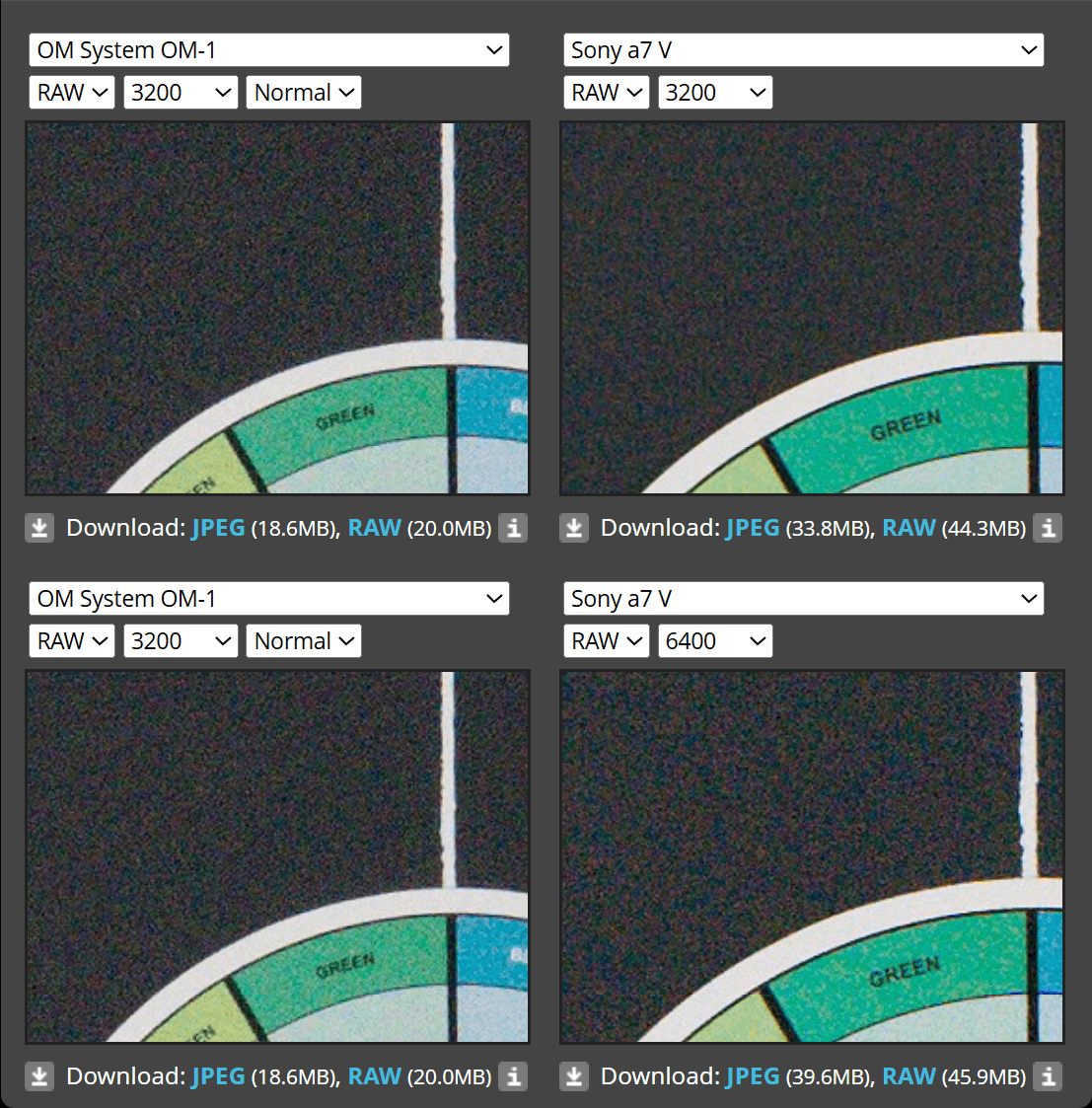
At the end of the day it’s the image that’s important, not just the data. The only consistent source of sensor noise information across multiple brands is the excellent DP Review test chart database. Noise test charts for the OM1 and the ARV are shown below (click and zoom if necessary to get a larger image). The test method uses the manufacturer’s ISO, unfortunately, and the ISO steps are in whole stops, so interpolation is required.
The DxO data indicates that the noise for the Sony at an indicated ISO 5000 should be the same as for the OM at an indicated ISO 3200 (you can only get this data from the actual DxO charts online). If you look at the images, you can see that the Sony noise is better than OM at 3200, and worse at 6400. It will be the same somewhere in the middle, i.e., around ISO 5000. So the DxO noise data seems borne out by the DP review test charts. It is also borne out by my personal experience.
Other sources of DR data: Bill Claff
Since DxO stopped testing, the only source of DR data on current cameras comes from Bill Claff’s Photons to Photos site, which only measures Dynamic range. Bill’s methodology is deeply mathematical, and I think it’s fair to say that few photographers understand it. Unfortunately, his ISO data uses the manufacturer’s number, not the true ISO, so the curves are not at all comparable between manufacturers.
It is possible to use the DxO ISO offset data to correct Bill’s numbers. However, the process is extremely complex, as you have to double interpolate from log-log graphs. Moreover, I am uneasy about mixing two test methodologies into a single data result. Bill uses his own method to analyse the DxO data (although he prefers his own methodology), and that seems to be a reasonable compromise. The Sony advantage again comes out as around one stop of DR at ISO 3200, fully offset by the faster OM lenses.
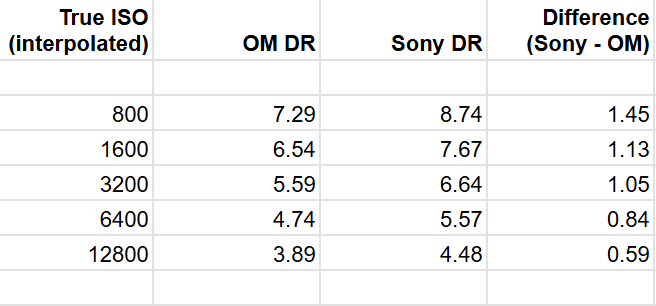
If you use Bill’s data and the DxO offset numbers, the Sony advantage is higher, at around 1.75 stops of DR. My personal preference is for the DxO data, as the methodology is consistent, does not involve interpolation, and lines up with the published DP review data and my own experience. Your mileage may vary.
TL;DR
There is almost no practical difference in dynamic range or noise between the OM and Sony wildlife zoom systems at 600-800mm FFE. Using DxO Labs data (the only source that corrects for manufacturer ISO overstatement), the Sony full-frame sensor has approximately a 1-stop advantage in dynamic range and a 2/3-stop advantage in signal-to-noise ratio over the OM Micro Four Thirds sensor at true ISO 3200. However, this sensor advantage is largely or fully cancelled by the faster maximum apertures of the OM Pro zoom lenses:
- At 600mm FFE, the OM 50-200 + MC14 at f4 is 1.3 stops faster than the Sony 200-600 at f6.3 — more than offsetting the sensor difference.
- At 800mm FFE, the OM 150-400 at f4.5 is 1.7 stops faster than the Sony 400-800 at f8 — again more than offsetting the sensor difference.
- At 800mm FFE, the OM 50-200 + MC20 at f5.6 is 1.0 stop faster than the Sony 400-800 at f8 — exactly offsetting the DR difference.
- The Sony 200-600 must crop into the sensor to reach 800mm FFE, losing not only resolution but also the full-frame DR advantage — a double penalty that makes it a significantly weaker proposition against the OM system than the raw sensor specs suggest.
Frequently asked questions
Why can’t I just compare DxO dynamic range scores between Sony and OM cameras directly?
Because almost all camera manufacturers overstate their ISO values, and DxO is the only test house that measured real ISO and used it in their DR and noise calculations. Without that correction, you are comparing numbers produced at different actual sensitivities, which makes the comparison meaningless. DxO has stopped testing new cameras, but their existing data provides the best available baseline for cameras like the EM-1 Mk II and the Sony A7RV.
How does lens aperture cancel out the Sony sensor advantage?
Dynamic range and noise are determined by how many photons reach the sensor — which depends on both sensor size and lens aperture. A faster lens lets in more light, directly offsetting a smaller sensor. At 600mm, the OM 50-200 with MC14 at f4 is 1.3 stops faster than the Sony 200-600 at f6.3. Since the Sony sensor advantage is approximately 1 stop, the OM system is ahead on net light gathered — despite the smaller sensor.
What is the double penalty suffered by the Sony 200-600 at 800mm?
The 200-600 cannot optically reach 800mm — it has to be cropped in post. Cropping reduces the active sensor area to roughly APS-C size, which means fewer photons per unit area and lower dynamic range. So at 800mm the 200-600 loses both the resolution advantage (shown in the resolution post) and the full-frame dynamic range advantage. Both penalties arise from the same crop.
Is Bill Claff’s Photons to Photos data reliable for comparing OM and Sony cameras?
For within-brand comparisons, yes. For cross-brand comparisons, it is unreliable without correction, because Bill uses the manufacturer’s stated ISO rather than the measured real ISO. Since Sony and OM overstate their ISOs by different amounts, the curves are not directly comparable. It is possible to correct for this using DxO’s ISO offset data, but the process is complex and involves double interpolation from log-log graphs — which introduces its own uncertainty.
Does AI denoising change the conclusion?
Yes, in favour of the OM system. AI denoise tools like DxO PureRaw and Lightroom Denoise are dramatically more effective on Micro Four Thirds files than their already-impressive performance on full-frame files suggests — partly because the MFT pixel pitch produces a different noise texture that the algorithms handle well, and partly because the starting point (after aperture correction) is already very close to parity. In practice, with AI denoise applied, the systems are indistinguishable at the ISOs relevant to wildlife photography.
Related Posts — OM vs Sony Series
Resolution
OM vs Sony Wildlife Zooms: Resolution Shootout
Focus Accuracy
Focus Accuracy Shootout: OM-1 II vs Sony A7V
Dynamic Range & Noise
Dynamic Range and Low-Light Noise: OM vs Sony
Lens Handling
OM and Sony Wildlife Zooms: Lens Handling
Zooms vs Prime
Sony Wildlife Zooms vs the 600mm f4 GMaster Prime
2026 Summary
OM and Sony Wildlife Zooms: 2026 Summary
Teleconverters & Focus
OM Pro Zooms: Effect of Teleconverters, ISO and Background on Focus Accuracy