Posts

  • Noise on Olympus vs Sony cameras for birds in flight

    The EM1x’s sensor has 0.5–1 stop higher read noise than the Sony A9, but system-level noise — accounting for lens speed, IBIS, and in-camera processing — is within 0.5 stops at the ISOs relevant to birds-in-flight shooting. The comparison most people make is unfair: they compare the A9 with a fast prime against the EM1x with a matched prime, where the Sony gathers more light per pixel, and then attribute the cleaner result entirely to sensor size.
  • EM1x and new firmware 2.0 operation for birds in flight

    I shoot the EM1x in manual with auto ISO, wide open, at 1/2000s minimum, with the rear dial set to exposure compensation and highlight/shadow blinkies as the only viewfinder overlay — a setup that lets me adjust exposure directly on the bird without any mode switching. Four custom presets (C1–C4) cover every BIF scenario, and ProCapture L at 15fps with 15 pre-shutter frames is assigned to C3 for takeoffs and landings.

  • New EM1x firmware 2.0 focus tests for Birds in Flight | mcaughtry.photo

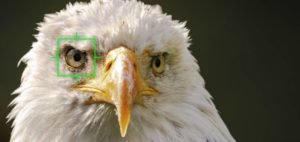
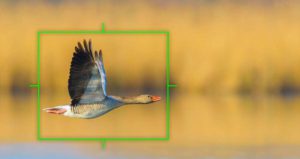
    The EM1x firmware 2.0 Bird AI tracking is a genuine improvement for stationary and slow-moving birds — the owl hit rate jumped to 48% in a session where previous sessions had produced far less — but in the fast-BIF sessions at the Hawk Conservancy Trust, it underperformed standard CAF: 45% versus 61% in the morning session. My conclusion is that Bird AI tracking works best combined with ProCapture L for subjects about to take off, not as a replacement for traditional CAF on birds already in fast flight.

  • Sony A9 vs Olympus E-M1x focus accuracy tests

    Over four days at the Hawk Conservancy Trust testing the Sony A9 and EM1x side by side, the A9 led in the morning focus-lock sessions (72% vs 61%) but the EM1x led in the afternoon focus-acquisition sessions (45% vs 39%). The overall averages were nearly identical — 51% EM1x, 49% A9 — but the EM1x achieved this with 600mm reach while the A9 was effectively capped at 600mm; with the 1.4TC at 900mm f9, the Sony hit only 34%.

  • Did YouTube damage the camera industry?

    The major YouTube camera channels are run by video producers, not photographers — their professional requirement is for sophisticated video features, and their advertising income depends on covering new products. Camera manufacturers responded to this increasingly important marketing channel by investing heavily in video capability for an audience that was actually shooting video on smartphones, and the R&D cost of those features was poured into a market contracting by 85%.

  • The lessons from owning too many cameras

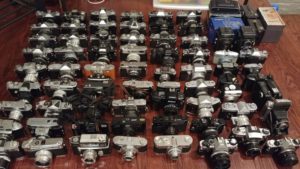
    After 56 cameras since the early 2000s — including DSLRs from Nikon and Canon, APS-C systems from Fuji and Sony, and multiple mirrorless generations — my conclusion is that APS-C offers no meaningful advantage over Micro Four Thirds while being nearly as heavy as full frame for travel. The practical test is airline carry-on limits: a full-frame system with a long telephoto exceeds them; the Olympus system fits comfortably, and I have not found a better all-round combination of features and portability at any price.

  • The decline of the professional photographer

    Stock photo royalties fell from an average of $280 per image in 2006 to approximately $4 by 2017 — a collapse that made stock photography commercially unviable for all but the highest-volume contributors. The rise of smartphones, affordable digital system cameras, and image-sharing platforms has eliminated the barriers to entry that once protected professional photographers, leaving only the highest-stakes genres like weddings and sports where the cost of amateur failure still creates a viable market.

  • The trials of being a Camera manufacturer

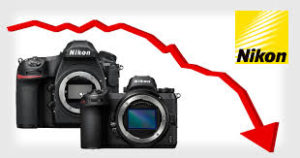
    System camera sales fell from 121 million units at peak in 2010 to 15 million by 2019, and Sony’s dominance of OEM sensor manufacturing means competitors must fund sensor R&D using camera revenues that are a fraction of what Sony earns from automotive, security, and smartphone sensors. Canon is the only remaining manufacturer producing its own high-end sensors; Olympus sold its camera division in 2020 rather than continue funding sensor development against that competition.

  • How Sony became the Kodak of the 21st century

    Kodak invented the digital sensor in 1975 and then lost its entire marketplace to digital competitors over the following 35 years; Sony invested in CMOS sensor technology from 1996 and now supplies the sensors used in cameras from Nikon, Fuji, Panasonic, and others, holding approximately 50% of the global image sensor market across all applications. The parallel with Kodak is exact: Sony’s sensors are the indispensable component for the camera industry in the same way Kodak’s film once was.

  • Are real cameras dead?

    Smartphones handle the vast majority of everyday photography — family, travel, documents — and for portraits of grandchildren in particular, the phone’s unobtrusiveness often produces better results than a dedicated camera. For wildlife, sport, long exposure, and large-format landscape printing, however, the physics of a smartphone sensor and lens still cannot deliver the reach, frame rate, noise performance, and resolution that the work requires.

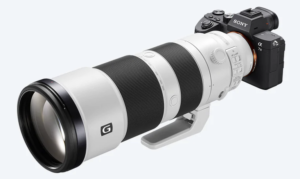
  • The Sony AR74 and the Sony 200-600 f5.6-6.3 lens, a non-functional combination for birds in flight?

    At Gigrin Farm, every one of approximately 1,000 shots with the Sony A7R4 and 200-600mm was out of focus — 100% failure rate — and a replacement lens made no material difference: 5% critically sharp out of 315 shots at Andover where the focus point was on the bird. Even when the AF points and the final focus point were both directly on the bird, only 6% of those shots were critically sharp, confirming a system-level flaw that Sony has never formally acknowledged.

  • State of the systems

    After buying the Sony A7R4 and 200-600mm intending to replace both my Nikon and Olympus systems with a single travel-friendly kit, the combination proved essentially non-functional for birds in flight — a problem well documented by others and not addressed by Sony. Extensive summer 2020 testing across every alternative confirmed the Olympus system as the best match for my requirements in every category: BIF focus accuracy, noise at matched apertures, long exposure capability, and travel weight.