Author: DMcA

  • Lofoten Long Exposure Seascapes

    In the long days where there was no photographable aurora, we took other photographs, mostly shots of land and sea. In the first few days I was so amazed by these views, I forgot to take any long exposure shots of the sea. The day I started to do this, I immediately dropped almost all my expensive Neutral Density (ND) filters, used to slow down the shutter speed, over the Hamnoy bridge, limiting my capability severely. Later that day, in a series of mishaps, I lost all the rest of my filters, and very nearly lost the camera as well. Despite this, I ended up with some reasonable shots, almost entirely taken with the OM1’s inbuilt computational ND facility. Here are the best of them.


    Touch or click any image to go to a lightbox view and then touch the full screen icon in the top right hand corner to get the best viewing experience. And for information on the shot and the location, be sure to click the little ‘i’ icon
  • Lofoten Aurora

    In March of 2023 I went with the excellent Steve Bell and two other very amiable fellow photographers to the Lofoten Islands on the far North Western tip of Norway. This was a trip that had been planned for 2 years, and was designed to coincide with a forecasted peak in aurora activity.


    The problem with photographing auroras is that a good aurora has to coincide with a clear night sky for any decent shots to be obtained. For the first 5 days of our 8 day stay we got either good weather or good aurora activity, but never both. However the vastly experienced Steve B was convinced our time would come, and indeed it did on the night of 23 March 2023. That night in Lofoten was one of the greatest aurora displays of the past decade, and certainly I never expect to see anything like it again. What I hadn’t expected was how fast things changed, as huge light displays across hundreds of kilometres of the night sky would suddenly appear, all around us, to be rapidly replaced by something else in a different direction.


    I used my Olympus OM1 for all these shots, and it fulfilled its promise as an excellent night sky camera. Features like auto focus against night stars, and enhanced night vision were absolutely essential for quick selection and capturing of the best aurora displays. This was my first ever aurora night sky trip, and one of my first ever night sky sessions, so the camera really had to help me here, and it did. In terms of how these photos look, unlike static night sky shots like the Milky Way, where many shots are taken and combined to reduce the noise, aurora photographs are single shot images because the content moves so fast. I used On1 Photo Raw which is normal “non-astro” software. I set the colour balance to obtain a dark blue night sky background and enhanced large details in the aurora areas, and all the colours you see fall out of those settings. I took 300 keepers that night, and I present the best 30 or so here. I hope you like them.


    Touch or click any image to go to a lightbox view and then touch the full screen icon in the top right hand corner to get the best viewing experience. For information on the shot and the location, click the little ‘i’ icon em>

  • Bempton vertical landings

    In June 2022, as a further check of the new OM1, I spent a weekend at Bempton with some friends. The Puffins had more or less gone, so I concentrated on getting shots of Guillemots and Razorbills coming in to land. While both of these birds leave the cliffs more or less horizontally, they arrive vertically, and they are the only birds I know that can fly forward while more or less fully upright. I love the way they look as they arrive. Capturing this is a challenge as they are so small it’s difficult to track them coming in as can be done with Gannets for example. I used the pro capture feature of the Olympus, which enables you to capture images after they have happened, through some computational wizardry, and that got me some nice sequences. AS a bonus, there are a few shots of Puffins at the end – the last ones of the season.


    Touch or click any image to go to a lightbox view and then touch the full screen icon in the top right hand corner to get the best viewing experience. And for information on the shot and the location, be sure to click the little ‘i’ icon

  • Cambodia: Long exposure shots of Kulen waterfall

    Kulen is a very attractive series of waterfalls, in the Phnom Kulen national park, 45km north west of Siem Riep. The first set of falls is rather touristy, but the larger, second set, shown here, which is accessible via a set of steep wooden steps is less developed, and early in the morning can be quite quiet. These long exposure shots were taken hand held, and without using filters, with my OM1 camera and new 8-25 f4 (16-50 full frame equivalent) lens. The computational power of the Olympus camera means that for waterfalls in particular, the tedious and error prone requirement for a solid tripod and filters is no longer needed, which is a breakthrough for travel photography, at least for me.


    Touch or click any image to go to a lightbox view and then touch the full screen icon in the top right hand corner to get the best viewing experience. And for information on the shot and the location, be sure to click the little ‘i’ icon

  • Cambodia: Phnom Penh Market scenes

    This is a companion to the market portrait series also taken in November 2022. This time the lens used was mostly a very fast wide prime lens (the Olympus 17mm, or 34mm full frame equivalent, f1.2). This focal length is the street photographers favourite for capturing situations or scenes, and this models’ excellent light gathering capability particularly makes it very handy in dark corners of the market, of which there are many.


    Touch or click any image to go to a lightbox view and then touch the full screen icon in the top right hand corner to get the best viewing experience. And for information on the shot and the location, be sure to click the little ‘i’ icon

  • Cambodia: Phnom Penh Market portraits

    Markets are a central part of SE ASian life, and I am particularly fond of those in Phnom Penh, the capital of Cambodia, and a city that gets more and more attractive each year (unlike almost all other cities in the region). Market traders and customers, particularly in the the non tourist areas, are a more interesting group of people than many of the fresh-faced office or shop workers that you see elsewhere in the city. You can see a lifetime of experience, not all of it good, on their faces and particularly in their eyes. Even middle-aged people in Cambodia will have a direct memory of the Khmer Rouge period, if not the Vietnam War, and I sometimes think you can see that in the thousand yard stare you sometimes come across. These shots were taken with a fast prime telephoto lens (the 75 mm f1.8) and my Olympus OM1 camera. A fast long prime lens is not often used for street photography but I find that this approach can sometimes get to the heart of the street particularly via the eyes. One feature of the lens is that the depth of field is very narrow so sometimes only the eyes are in sharp focus, but it’s the eyes I am interested in.


    Touch or click any image to go to a lightbox view and then touch the full screen icon in the top right hand corner to get the best viewing experience. And for information on the shot and the location, be sure to click the little ‘i’ icon

  • Cambodia: Prek Toal and Siem Pang wildlife reserves

    After a Covid-induced gap, I returned to Cambodia in November 2022. On the wildlife front, I again visited the Prek Toal nature reserve, in a tributary off the giant Ton le Sap lake in central Cambodia. This was followed by a visit to the extraordinary Siem Pang wildlife reserve close to the Lao border in NE Cambodia, run by the remarkable Jonathon Eames OBE. This sanctuary, not open to the public, exists primarily to preserve the last surviving Giant Ibis population in SE Asia, of which there are only around 200 adults remaining in the world, but also houses one of the last populations of White Rumped and Slender billed vultures, of which less than 1000 remain in the world. I didn’t get to see any Giant Ibis here, but did see white backed and slender billed vultures at the amazing if slightly unedifying Buffalo restaurant, as well as the also rare Lesser Adjutant and some very attractive dragonflies.


    Touch or click any image to go to a lightbox view and then touch the full screen icon in the top right hand corner to get the best viewing experience. And for information on the shot and the location, be sure to click the little ‘i’ icon

  • Superfast Falcon and Kite shots with the OM1

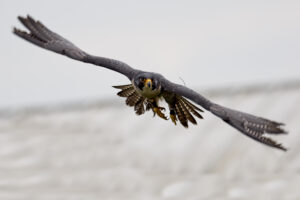
    The Peregrine Falcon is the fastest animal in the world, and is able to dive at speeds of up to 240mph. It’s a quite a small bird, so a long 600mm focal length is needed. Trying to follow something travelling that small and fast through a 600mm telephoto, and capturing key moments is impossible for me except via blind chance (spray and pray).
    The test results from my first trip to the HCT with the new OM1 camera were very encouraging (see previous album). They made me wonder if I could use the camera with a clever little gadget called a “dot sight” to get previously difficult or impossible shots of Falcons and Kites. The dot sight makes finding the Falcon with a telephoto lens much easier, but the focusing system then needs to be super responsive and super accurate.
    The Sony A9 or A1 cameras are not fast enough and the big Sony lenses are not manoeuvrable enough to achieve this. But the OM1 is both small and super quick. And it worked. I was able to get images of the Falcon capturing its lure on the wing – something I’ve not managed in over a dozen attempts before. In addition I got some amazing shots of Kites chasing vertically after catapulted pieces of chicken – more shots than in all previous visits put together. All in all an amazing result for the OM1 – the best camera for this kind of bird photography in the world!


    Touch or click any image to go to a lightbox view and then touch the full screen icon in the top right hand corner to get the best viewing experience. And for information on the shot and the location, be sure to click the little ‘i’ icon

  • Hawk Conservancy Trust try-out for new OM1 camera

    I got my spiffy new OM Digital Solutions OM1 camera in early March 2022, and have been wanting to try it out on some intensive bird in flight action. Once the half-term and having fun with Grandkids period was over, I headed down to the Hawk Conservancy Trust in Andover to run it through it’s paces. The weather was great, and I took over 6000 test shots. I have taken so many photos at the HCT that I only bother putting up interesting ones – so here are 17 of those 6k shots. By the way the OM1 performed very well, and the results are written up in my posts section. All these shots were processed in one morning in On1 Photo Raw 2022.


    Touch or click any image to go to a lightbox view and then touch the full screen icon in the top right hand corner to get the best viewing experience. And for information on the shot and the location, be sure to click the little ‘i’ icon